Scientific Leaders: "No Anthropocene" Vote Was a Sham
 Readers of the New York Times opened their papers today to a giant photo of Donald Trump appearing above the headline “Geologists Say It’s Not Time to Declare a Human-Created Epoch”. (The photo of Trump was attached to a different story.) The article, written by reporter Raymond Zhong (who has been on the climate beat for two and a half years), appeared online yesterday with the headline “Are We in the ‘Anthropocene,’ the Human Age? Nope, Scientists Say.”
“A panel of experts voted down a proposal to officially declare the start of a new interval of geologic time, one defined by humanity’s changes to the planet,” the article summarizes. Zhong quotes panel members Aarhus University geologist Jan A. Piotrowski and University of Wales Trinity Saint David stratigrapher Mike Walker, who voted against the proposal.
The chair and second vice-chair of the panel in question, the Subcommission on Quaternary Stratigraphy (SQS) of the International Commission on Stratigraphy (ICS) within the International Union of Geological Sciences (IUGS), have now forcefully announced the vote was a sham and should be considered “null and void”.
In brief, the alleged voting and the process surrounding it is open to challenge based on the grave violation of the ICS Statutes and thus must be considered null and void.
They report that the improper vote was instigated by Peking University geologist Liping Zhou, first vice-chair of the panel, and University of Florence paleoclimatologist Adele Bertini, secretary, despite opposition from the chair, University of Leicester geologist Jan Zalasiewicz, and second vice-chair Martin J. Head, a stratigrapher at Brock University.
Zalasiewicz and Head note that “a large majority of SQS members who took part in the alleged voting” (11 out of 16) were “not eligible as voting members at the time they cast their votes,” as they had been members of the subcommission for more than 12 years. The five eligible members do not represent a needed quorum for a vote to take place.
Moreover, the sham vote was held even as a Geoethics Commission report on the workings of the subcommission’s Anthropocene Working Group (AWG) was being reviewed by the president of the IUGS, geologist John Ludden. Zalasiewicz requested the report be distributed to the subcommission members before any vote was held, but Zhou and Bertini ignored him and pushed forward the sham vote, with members notifying the New York Times about the fraudulent result. Ludden released the report to the SQS and the AWG on March 5th, after the Times story was published. According to Zalasiewicz,
The findings of that report included: that the AWG, in preparing its proposal, was unfairly treated, via conflicts of interest, application of different standards than to other working groups, and unreasonable requests and restrictions, while insufficient time was allowed for comment on the proposal, and the AWG were not asked to provide feedback on the discussions as would be normal practice. The Geoethics Commission further observed that the process as a whole between AWG/SQS/ICS/IUGS was dysfunctional; it thus recommended the urgent suspension of any voting procedures (though not examining their validity).Panel member Naomi Oreskes, a historian of climate science, responds:
The irregularities in the SQS voting procedures strongly suggest that the SQS did not make its decision on scientific grounds. The argument put forward by the AWG—and overwhelmingly endorsed by the AWG membership—was never given a fair hearing.What’s particularly sad about this to me—as a person who cut my teeth in field geology—is that by rejecting the Anthropocene proposal, the SQS suggests to the world that they are unwilling or unable to recognize what we all can now see: that we do indeed live in the Anthropocene. By denying the obvious, the stratigraphers threaten to undermine the credibility of the science that they claim to be protecting.
The full text of the press statement from Profs. Zalasiewicz and Head and Zalasiewicz’s report to the subcommission, are below.
2023 Election Results
Governors
The incumbent governors in Kentucky and Mississippi were re-elected in Tuesday’s two gubernatorial elections. Kentucky’s Democratic governor Andy Beshear was re-elected, and used his acceptance speech to personally thank Hadley Duvall, a rape survivor who spoke out powerfully against the extreme position on abortion held by Beshear’s opponent. Beshear will now get another term to promote new manufacturing and EV jobs despite the legislature’s best efforts to prop up King Coal.
In Mississippi, Republican governor Tate Reeves defeated Democratic Public Service Commissioner Brandon Presley, whose campaign for Medicaid expansion and against Reeves’ corruption was not enough to overcome Mississippi’s strong Republican tilt.
Virginia
In Virginia, Democrats kept their majority in the state senate by a 21-19 margin, and flipped control of the House of Delegates, winning at least a 51-48 majority. (The Republican candidate is holding on to a slim lead in the race for HD 82, but that race has not been called.) The majority maker was Climate Cabinet-endorsed Michael Feggans in HD 97, where investments to protect Virginia Beach from flooding are an important issue. Joshua Cole, a Mountain Valley Pipeline opponent endorsed by both Climate Cabinet and Lead Locally, won his election for HD 65 around Fredericksburg. With Lead Locally’s support, activist Nadarius Clark was elected to represent the Suffolk-based HD 84.
Climate Cabinet also endorsed Russet Perry in her successful Loudon County race for SD 31, where she prevailed over a far-right son of a billionaire. For his leadership backing clean energy investments in a swing district centered around Newport News, Climate Cabinet had endorsed Democratic senator Monty Mason (D-SD 24). Mason was narrowly defeated by Danny Diggs, causing a net loss of one seat for Virginia Senate Democrats. Nevertheless, the June primary victories of Senators-elect Lachrese Aird, Jennifer Carrol Foy, and Saddam Azlan Salim, along with the retirement of Dominion Energy ally Dick Saslaw, will likely add up to a more progressive and unified Democratic caucus in the senate next year.
With these results, Virginia is likely to continue as the clean energy leader of the South. Democrats have dealt a serious blow to governor Glenn Youngkin’s plans to dismantle the climate progress made under his predecessor. In interviews with Inside Climate News, environmental leaders previewed their strategy for expanding rooftop solar and offshore wind even as Youngkin, who is described as “mostly hostile to climate policy,” remains in office for two more years. Inside Climate News notes:
One area where the Democrats now hold complete control is over the State Corporation Commission, or SCC, the regulatory body that oversees insurance, businesses, and—critically for the state’s climate goals—utilities. In Virginia, the dominant utilities are Dominion Energy and Appalachian Power Company.The SCC is meant to set utility rates that are fair for both consumers and companies. It also approves or denies the utilities’ decarbonization plans, which are needed to comply with emissions reductions mandated in the Clean Economy Act.
At the moment, the SCC is not fully operational. While two members are needed for the SCC to issue rulings, only one seat on the three-person board is filled. But SCC positions are legislative appointments, meaning with Democrats in the majority, they now control who will fill the two empty positions.
“The future of the SCC is in their hands,” said Shelby Green, a researcher at the Energy and Policy Institute, a watchdog group.
Hydrogen Hype's Physics Problem
 The Biden administration is spending billions on the National Clean Hydrogen Strategy, even recently celebrating Hydrogen Day on October 8 (because hydrogen’s atomic weight is 1.008) to “mark a symbolic opportunity to celebrate hydrogen—clean hydrogen, specifically—and the crucial role this element plays in supporting a robust, equitable clean energy future for all Americans.”
“There’s a lot to like about hydrogen as a fuel source, climate journalists such as David Gelles gush.
The only problem is that “clean hydrogen,” also known as “green hydrogen”—that is, hydrogen gas generated using renewable electricity—isn’t particularly “clean” or “green,” although it’s less polluting than “gray” and “blue” hydrogen, produced from natural gas.
Unfortunately, even “green” hydrogen is a powerful greenhouse pollutant.
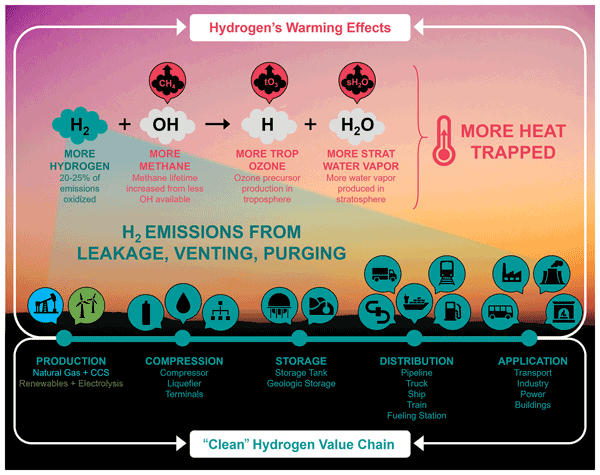
As an important paper from Environmental Defense Fund scientists Ilissa Ocko and Steven Hamburg explains, hydrogen is unavoidably leaky, because it’s such a small molecule, and like methane, has a high short-term warming effect. In fact, one of hydrogen’s main warming effects is to increase the atmospheric lifetime of methane. Methane breaks down in contact with the hydroxyl (OH) radical formed when ultraviolet light interacts with ozone (O₃) and water vapor (H₂O). Hydroxyl also reacts with hydrogen molecules (H₂), so significant hydrogen pollution means atmospheric methane doesn’t break down. Thus, Ocko and Hamburg find:
Hydrogen’s 100-year greenhouse warming potential (GWP) is twice as high as previously thought, and its 20-year GWP is 3 times higher than its 100-year GWP. Hydrogen’s maximum GWP occurs around 7 years after the initial pulse of emissions, with a range of 25 to 60 based on uncertainties, and a central estimate of 40.
In short, “green” hydrogen isn’t.
Scientific American 1856: Scientific Ladies - Experiments with Condensed Gases.
 From Scientific American, Volume XII, Issue 1, published September 13, 1856.
Scientific Ladies - Experiments with Condensed Gases.
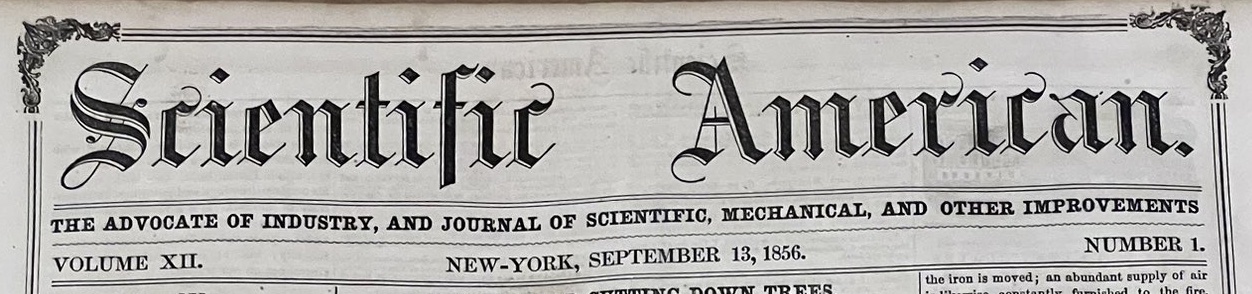
Some have not only entertained, but expressed the mean idea, that women do not possess the strength of mind necessary for scientific investigation. Owing to the nature of woman’s duties, few of them have had the leisure or the opportunities to pursue science experimentally, but those of them who have had the taste and the opportunity to do so, have shown as much power and ability to investigate and observe correctly as men.
We have Miss Mitchell, who has been awarded the King of Denmark’s prize medal for her discoveries in astronomy; and there is Mrs. Somerville, of London, whose work on physical geography is one of the finest contributions to physical science ever published. So highly gifted is this lady, and so profoundly versed in the science, that the late Prof. Caldwell, of Louisville, who had an opportunity of conversing with her, and also seeing her perform some experiments, declared “she was deeply acquainted with almost every branch of physical science.” Other cases might be mentioned, but these are sufficient for our purpose.
Our constant readers will remember that several articles from different persons appeared in the last volume of the SCIENTIFIC AMERICAN, relating to solar heat at the surface of the earth. The question was introduced by Wm. Partridge, of Binghamton, who took the position, that density of the atmosphere, and not the angularity of the sun’s rays, was the principal reason why it was warmer in valleys than on the tops of mountains. His views were opposed by other correspondents, but none of them supported their opinions with practical experiments to decide the question; this we are happy to say has been done by a lady.
A paper was read before the late meeting of the Scientific Association, by Prof. Henry for Mrs. Eunice Foot (sic), detailing her experiments to determine the effects of the sun’s rays on different gases. These were made with an air pump and two glass receivers of the same size—four inches in diameter, and thirty in length. The air was exhausted from one and condensed in the other, and they were both placed in the sun light, side by side, with a thermometer in each. In a short period of time, the temperature in the receiver containing the condensed air, rose thirty degrees higher than the other ; thus proving conclusively that the greater density of air on low levels is at least one cause of greater heat in valleys than on mountains. Experiments were also tried with moist air, and its temperature was elevated above dry air. Hydrogen gas was placed in one receiver and oxygen in the other, when the temperature of the former rose to 104°, but the latter to 106° Fah.; while, in carbonic acid—a more dense gas than either—it rose to 126°.
It is believed and taught by geologists that during the period preceding the carboniferous era,—when the coal bed materials were forming—that the atmosphere of the earth contained immense quantities of carbonic acid, and that there was a very elevated temperature of atmosphere in existence, in comparison with that of the present day. Those who believe that this earth was once a fiery ball, attribute this ancient great atmospheric heat to the elevated temperature of the earth; but Mrs. Foot’s experiments attribute it to a more rational cause, and leave the Plutonists but a small foundation to stand upon for their theory.
The columns of the SCIENTIFIC AMERICAN have been oftentimes graced with articles on scientific subjects, by ladies, which would do honor to men of the highest scientific reputation; and the experiments of Mrs. Foot afford abundant evidence of the ability of woman to investigate any subject with originality and precision.
via Ana Unruh Cohen
AGU Quietly Began Divesting From Fossil-Fuel Industry in 2021
 After years of protests from its climate-scientist members for its ties to climate polluters, the American Geophysical Union quietly divested its $100-million-plus investment portfolio from the fossil-fuel industry. In November 2021, AGU leadership posted a video labeled only “AGU announces change in its investment strategy.” In the video, AGU president Susan Lozier announced the implications of its newly adopted ESG investment policy:
Also as a result of this policy, AGU has no direct investments in fossil fuels. However, a recent audit of AGU’s portfolio showed that approximately five percent of our holdings are invested in fossil fuels through our mutual fund accounts. Today’s announcement is to let you know that AGU has started to divest its portfolio of these holdings to strengthen our commitment to mission-related investments and to better align with our strategic plan, which places a strong focus on a sustainable future.In the video, AGU president-elect Susan Gramlich explained the decision was a result of the “unprecedented climate emergency” which makes this an “all-hands-on-deck moment for our scientific community,” while recognizing that AGU members include employees of fossil-fuel companies.
As Susan mentioned, AGU’s Board’s decision was focused on making sure our actions match our strategic plan, who we are as an organization and our investment policy. Core to all three is that we must address our global climate crisis. The world is facing an unprecedented climate emergency where every decision – and inaction – affects all who inhabit our planet. This is an all-hands-on-deck moment for our scientific community as we are called upon to continue to build our capacity to anticipate the impacts of climate change and work with others to ground policy and practices in our science. As we continue to pursue our science, we are also engaging with an ever broadening array of fields of expertise from scientific to social to political. We aspire to deepen our collaboration with the private sector, especially those companies that are committed to truly doing better for future generations by advancing science-based solutions. . . Our members also work in and for a variety of organizations, including non-profits, academia, scientific organizations, government programs and corporations, including fossil-fuel companies.
AGU past president Robin Bell, a cryosphere geophysicist, discussed the AGU Finance and Investment Committee’s plan for “net carbon neutrality” with AGU investments, which opens the door for further investment in the fossil-fuel industry.
The current landscape is very dynamic and as Earth scientists, we understand that the fossil fuel companies have the potential to become truly renewable energy companies driving carbon sequestration and direct air capture. Carbon Capture and sequestration will be essential to meet the Paris Agreement goals. We know developing robust metrics for a carbon neutral portfolio will not be simple given the complexities of the carbon cycle. We will build on the evolving understanding of carbon in the Earth system that our membership brings to this discussion. We are grateful for the work of our scientists and will be looking to our community to help us hone our strategies.At that time AGU adopted a new investment policy with the vague language:
Based on a desire to align the Long-Term investments with the mission of the organization, AGU will emphasize Mission Related Investments (“MRI”) that include the following characteristics: Environmental, Social and Governance (“ESG”) integration, thematic investments, transparency and women and minority owned or managed investments.In a June 2022 communication with Scientists for Global Responsibility, executive director Randy Fiser confirmed:
To better align with our new strategic plan, which places a strong focus on a sustainable future, and to strengthen our commitment to mission-related investments, the AGU Board of Directors voted to entirely divest AGU’s portfolio of fossil fuels, starting October 2021. We recently announced this decision in a From the Prow post.
The post to which Fiser refers is the one having only the vaguely named video.
It remains unclear whether AGU has any policy or standard against accepting funding and sponsorships from fossil-fuel companies, the subject of massive protest from members in 2016. At the time, the board rejected member calls to sever its long-standing financial and promotional relationship with ExxonMobil. Although Exxon chose not to continue its sponsorship of the Fall Meeting student breakfasts, Chevron continued as a sponsor of Fall Meetings through 2019. No fossil-fuel companies were public sponsors for the 2020, 2021, or 2022 meetings.
At the 2022 fall meeting in December, AGU expelled climate scientists Rose Abramoff and Peter Kalmus for interrupting a plenary session with a call for their fellow AGU members to engage in more climate activism. AGU staff complained to Abramoff’s employer, Oak Ridge National Laboratory, leading to her firing in January 2023.
Climate on the 2022 Ballot
California
Prop 30, Tax on Income Above $2 Million for Zero-Emissions Vehicles and Wildfire Prevention Initiative
Proposition 30 would raise income taxes by 1.75% on Californians who make more than $2 million annually, spending 80% of the estimated $3.5 billion in yearly revenue on electric vehicle (EV) charging stations and rebates for EV purchases, and the remaining 20% on wildfire fighter hiring and training. The California Air Resources Board (CARB) would be directed to prioritize low-income Californians in allocating EV rebates.
California governor Gavin Newsom has decried Prop 30 as a “Trojan horse” initiative and cut an ad opposing it. Newsom’s argument points to Lyft’s substantial funding for the measure, motivated by its desire to have the wealthy subsidize its compliance with a new CARB rule requiring 90% of ride mileage to come from EVs by 2030. It’s a reasonable complaint, but curious coming from someone who was silent two years ago when Lyft spent millions to overturn a California labor law to stop misclassifying drivers.
With support from the California Democratic Party, many labor organizations, billionaire Tom Steyer, legislators like state senator Henry Stern and Rep. Ro Khanna, and environmental organizations, polls show Prop 30 in a pretty strong position to pass (albeit with gradually declining support). We will see if Prop 30’s support holds up against Newsom, the California Chamber of Commerce and Teachers Association, and scolding editorials from the San Jose Mercury News and the LA Times.
Florida
Amendment 1, Disregard Flood Resistance Improvements in Property Value Assessments Measure
If approved by 60% of voters, Amendment 1 would exempt expenditures on home flood resilience improvements from property tax value assessments. The measure is meant to encourage flood mitigation investments by Florida homeowners. One third of the 5 million policyholders in the National Flood Insurance Program (NFIP) live in Florida, and 1.7 million Floridians live in an area that is subject to 100-year flood risk— a figure that is projected to grow considerably in the years ahead.
A long-term reauthorization of the NFIP is needed to modernize flood mapping, provide resources for flood mitigation, and expedite the buyout process for many Florida homeowners who really should relocate. But Congress has perpetually “kicked the can” down the road on NFIP reform. Although the Build Back Better Act included significant reforms, that died in the Senate. With the U.S. Congress failing to provide NFIP relief, a near-unanimous vote of the Florida legislature placed Amendment 1 on the ballot.
Lest we give Florida lawmakers too much credit, an emergency session in May utterly failed to address the climate-driven property insurance “meltdown” taking place there. Available reforms to make insurance more affordable, and shore up Florida’s state-funded reinsurance company by taxing corporations rather than individuals, were rejected.
Georgia
Amendment 2: Temporary Property Tax Change for Disaster Areas Measure
Similar to Amendment 1 in Florida, Georgia’s Amendment 2 would allow temporary property tax relief for any homes that are damaged by climate disasters, if it receives approval from 2/3 of the voters. Georgia has among the most regressive and meager tax systems in the country.
New York
Proposal 1, Clean Water, Clean Air, and Green Jobs Environmental Bond Act
If approved, Proposal 1 would authorize $4.2 billion in general obligation bonds for projects dealing with climate change resilience, including wetlands restoration to mitigate sea level rise, heat pumps, electric buses, and other home energy upgrades. 35% of the bond revenue is required to be dedicated to disadvantaged communities. If passed, Prop 1 will be the first environmental bond act that New York voters have seen in 26 years. It was originally slated to be on the 2020 ballot, after former governor Andrew Cuomo pointed to reports citing mounting state infrastructure costs from climate change. After the pandemic caused the bond measure’s postponement, governor Kathy Hochul revived the effort last year, and called for an additional billion dollar in funding, which some legislators felt was still inadequate. The New York Public Interest Group suggested that the bond should follow the “polluter pay” model of past NY environmental bond measures and repeal fossil fuel subsidies, but those calls were not heeded.
Manchin Permit Plan Mimics Rejected Capito-Inhofe Amendment to Inflation Reduction Act
 In a press briefing on Thursday, White House press secretary Karine Jean-Pierre announced “we support the permitting reform bill” backed by Sen. Joe Manchin (D-W.Va.), even though full text of the legislation has not been publicly released.
Remarkably, Jean-Pierre criticized the existence of the permitting process, saying, “Permitting always delays a new solar and new wind projects are among the longest in our — in our country.” [sic]
In August, Manchin told West Virginia Metro News that his permit plan “is something the Republican Party has wanted for the last five to seven years I’ve been with them.” Explaining the plan to attach his permit bill to the government-funding continuing resolution, “It either keeps the country open, or we shut down the government. That’ll happen Sept. 30, so let’s see how that politics plays out.”
Manchin expects the support of Republicans who are the strongest advocates of the fossil-fuel industry in the Senate, such as Sens. Shelley Moore Capito of West Virginia, Jim Inhofe of Oklahoma, John Boozman of Arkansas, and John Barrasso of North Dakota, who have, as he noted, attempted to restrict environmental review of energy projects for years.
Inhofe and Barrasso are notoriously the most extreme proponents of climate denial in the Senate.
The exact language of the plan, expected to be released today, is unclear. As of year, there is only a one-page summary of Manchin’s plan and leaked draft legislation with an American Petroleum Institute watermark.
Sens. Capito and Inhofe proposed an amendment to the Inflation Reduction Act that would have compelled the construction of the Mountain Valley Pipeline and greatly restricted environmental review, as Manchin’s one-pager intends. As expected, the amendment was ruled out of order for a reconciliation bill and not voted on.
Atmospheric methane continues to rocket up at record rates
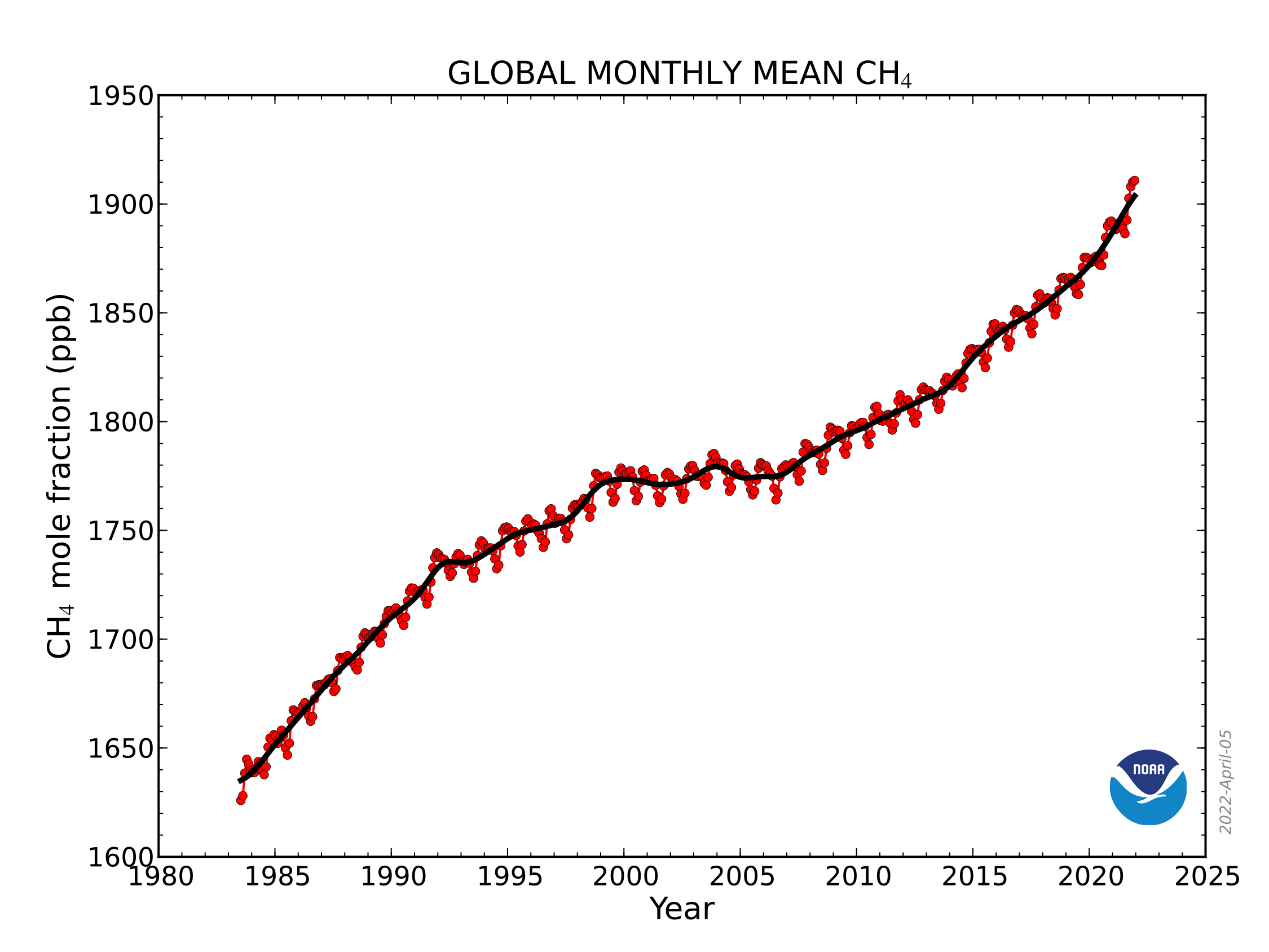 Atmospheric methane continues to rocket up at record rates, NOAA reported yesterday. As fracking booms, methane levels increased by 17 parts per billion in 2021, breaking the 2020 record of 15.3 ppb. Concentrations of this powerful greenhouse pollutant are now 162 percent of their pre-industrial levels, as the Biden administration pushes for more natural gas production and export.
I will take this moment to remind readers that the EPA is undercounting methane pollution by 77 percent.
The essential Kate Aronoff castigates the incoherence of Democrats in Congress who claim to care about the climate crisis begging oil CEOs to increase fossil-fuel production, instead of acting to take their billions in windfall profits and stop their greenhouse pollution:
Appealing to these CEOs’ better angels is pointless. Although they hand fossil fuel companies billions in subsidies each year, American policymakers mostly confine themselves to begging or berating them into doing what they want.
As Adam Tooze writes in his review of three recent books by Andreas Malm:
To harp on the climate crisis while doing nothing about it is, in the long run, intolerable. Liberals’ failures make Trump look honest. He may deny the science, but at least he’s true to himself.
The EPA is undercounting methane pollution by 77 percent
The oft-repeated claim that the United States has significantly reduced its greenhouse pollution since 2005 by switching from coal to gas depends on the EPA’s official accounting that methane pollution has declined during the fracking boom, an implausible scenario.
Today, the International Energy Agency revealed in a major report that methane pollution from the fossil-fuel industry is 70 percent higher than official figures globally. Their Global Methane Tracker finds that the U.S. Environmental Protection Agency has been seriously undercounting methane pollution. The IEA estimate of 2021 methane pollution is 77 percent higher than the EPA’s inventory:
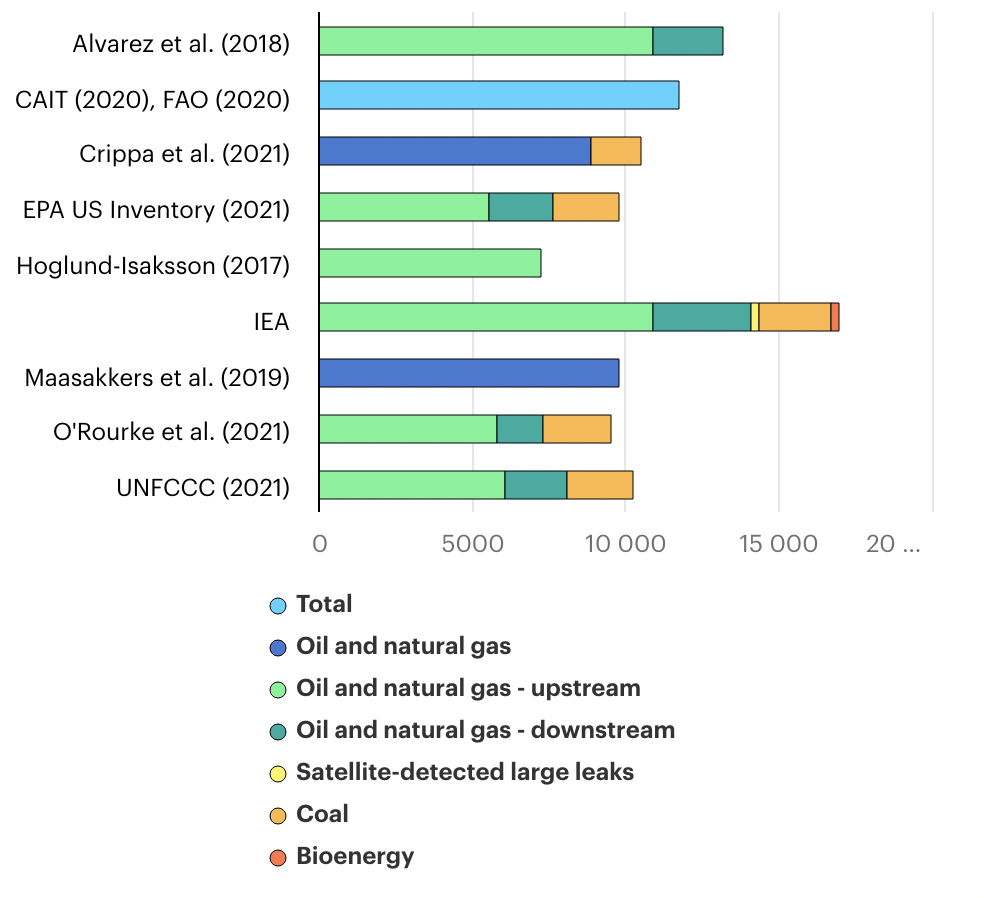
United States methane pollution from energy sources in 2021. EPA estimate: 9,600 kT; IEA estimate: 17,000 kT
Not surprisingly, that cancels out all the purported climate benefits of switching electricity production from coal to natural gas.
Furthermore, the U.S. EPA calculates the effect of methane on global warming by using its impact over 100 years, which is about 30 times that of CO2, instead of more scientifically defensible dynamic measures that take into account methane’s 20-year impact, which is 86 times that of CO2.
3/7/20 Update: Russia invaded Ukraine the day after the IEA report dropped, so that may help explain why this report didn’t get too much attention. However, the oil and gas industry are claiming the invasion means we have to drill everywhere, and the Senate Energy Committee found time to attack FERC for regulating methane pollution. So I think there’s capacity to discuss this report and its shattering implications, which include the need for the United States to shut down the fracking boom as fast as humanly possible.
A Review of Neal Stephenson's Termination Shock
“People were expensive; the way to display, or to enjoy, great wealth was to build an environment that could only have been wrought, and could only be sustained from one hour to the next, by unceasing human effort.” — Neal Stephenson, Termination Shock
 One of my favorite techniques in science fiction is taking pop-culture jokes seriously, expanding upon their ramifications with character, setting and story. Bruce Sterling’s 1998 gem Distraction opens with members of a local Air Force base holding a shake-down bake sale.
Neal Stephenson’s 2021 stratospheric-geoengineering treatise Termination Shock launches with an attack by “30-50 feral hogs,” inspired by a tweet that launched a memetic debate over whether and how much the threat of backyard feral hogs are “legit” or ridiculous.
Stephenson convincingly demonstrates that the feral hogs overrunning Texas are a demonic scourge, in an extended opening sequence in which the hereditary queen of the Netherlands, Frederika Mathilde Louisa Saskia, barely survives a plane crash caused by a roving herd.
The herd is led by a Moby-Dick-esque beast known as Snout, who killed the young daughter of one of the other main protagonists, Rufus “Red” Grant, in his yard in rural Texas. Having tracked Snout’s herd for years, Grant saves the queen and kills his nemesis. He then helps her make her rendezvous with the cornpone oil billionaire T.R. “McHooligan” Schmidt, who has begun secretly launching sulfur rockets into the stratosphere to dim the sun. This rogue effort is a cheap way to simulate the effects of nuclear winter enough to counteract the deadly buildup of greenhouse pollution, as long as the rockets keep going.
If that sounds like an enjoyable start to a novel, then you probably have read other books by Stephenson. Unfortunately, it’s by far the most dynamic sequence of the book. The beginning thrill ride is pretty much a headfake, as the book switches erratically to its main topic of geoengineering and becomes, even by Stephenson’s standards, boring and talky.3
The vast majority of the rest of the 720-page tome offers an extremely good sense of what it would be like to hang out with techno-billionaires like Nathan Myhrvold and Jeff Bezos, offering several practical tips on how to stay on their good side (he’s worked for both).
In interviews, Stephenson has said that Termination Shock is meant to describe “the geopolitical reaction” to global warming and the potential decision to engage in geoengineering. His goal was to have “realistic characters having realistic arguments” about geoengineering, in order to “make it a topic of conversation.”
I do think this is a helpful entry in spurring that needed conversation. But on its own, the book is less a serious investigation of the geopolitical ramifications of geoengineering than a monologue from a globe-trotting techno-enthusiast. I do wish his characters had any real psychological differences. It’s great to be reminded that gender, race, and wealth are irrelevant to whether you are a reliable, hyper-competent, semi-horny techno-enthusiast MacGyver, but it’s genuinely difficult to tell the characters apart when they’re talking.
So while it goes into remarkable detail on the mechanisms of the sulfur-launcher and the Netherlands’ movable seawalls, Shock’s political analysis doesn’t go much deeper than: it’s hard to cut carbon pollution, Greens don’t want us to do anything, geoengineering might benefit some regions and might harm others.
For example: by necessity of making the rogue billionaire geoengineer something of a good-guy protagonist, Termination Shock is blithely optimistic about the reliability of climate-model downscaling of the impacts of stratospheric sulfur injection. There’s the repeated implication that there would be clear regional winners and losers, as opposed to new and different forms of anthropogenic climate chaos.
As a novel, _Termination Shock_—whose truly global scope may be its strongest attraction— feels a bit too much like a collection of magazine-length travelogues; the stitching still shows. That said, the up-to-the-minute references to COVID and QAnon and the January 6 insurrection imply that awkwardness may be deliberate. Stephenson is okay with breaking the fourth wall, reminding the reader that the novel’s characters don’t exist but that the real world very much does. Set vaguely in the future, Shock is fundamentally a 700-page essay of Stephenson’s opinions at and about the moment of writing (June 2021).
As explicitly-of-the-moment climate-politics tracts go, I greatly preferred Swedish author Andreas Malm’s Corona, Climate, Chronic Emergency, written and published a year earlier. It too has great cover art, punchy writing, and covers our global climate politics with greater insight and depth in less than a third as many pages.
However, I enjoyed Termination Shock much more than Kim Stanley Robinson’s Ministry for the Future, a 560-page assemblage which has been heralded as a serious work of climate fiction. I won’t go into my feelings about Ministry here (if you’re deeply interested, here’s a thread), but one element of comparison is worth raising. Robinson has India do stratospheric sulfur injection without sparking World War III, whereas Stephenson has the U.S. (technically, a rogue American) do it. So, I guess they’re both optimists. Unlike Ministry, though, Shock doesn’t even try to imagine turning off the fossil-fuel spigot.
So far, of the three white western-American-male climate SF novels I’ve read recently —_Termination Shock_, Ministry for the Future, and Paolo Bacigalupi’s Water Knife, written in 2016—I feel that only Water Knife fully worked as a novel and an analysis of politics and society under global warming.
Some of that may simply be because Bacigalupi didn’t make technocrats, royalty, or billionaires his protagonists. They certainly exist in his narrative and shape it, but their stories are, in the end, kind of boring. Like Ministry and Shock, Water Knife begins with heart-stopping action, but then doesn’t let up. It’s a much more harrowing read, but I think it would be a mistake to think of it as dystopic and the others as optimistic—they’re stories focusing at different moments of different people’s lives on one functionally equivalent near-future hothouse Earth.
I’ve been an admirer and enthusiast of Stephenson since reading Snow Crash when it came out in 1992. It was a particular delight to discover his earlier books, The Big U and Zodiac, were thinly fictionalized depictions of his and his friends’ adventures in my hometown of Boston. He was literally one of those cool weird environmentalist techno-geeks I admired as a teenager.
Termination Shock has been described as Stephenson’s first global-warming book, but Zodiac was a roman à clef about a Greenpeace activist, Snow Crash depicts hordes of climate refugees swarming a newly temperate Alaska, Diamond Age a post-21st-century-World-War-III global society, Seveneves the apocalypse. So it would be better to say this is the first time Stephenson’s work has been branded as climate fiction.
The books also track Stephenson’s progress in society, from the scrappy dirtbag protagonists of the Big U, Zodiac, and Snow Crash to the scrappy dirtbags, billionaires, and queens of Reamde, Fall, and Termination Shock. He writes what he knows!
It is fun to read T.R. Schmidt’s plot-driving actions, magpie personality, and love for explanatory bloviation as a stand-in for the author as he constructed this novel. This, for example, could be authorial self-description: “T.R. was the living embodiment of what was now denoted ADHD. He went off on tangents, a small percentage of which made money.”
The tangent-prone Stephenson really can write action sequences! And depictions of complex machinery! He and his characters have a great sense of humor and a deep appreciation for cool. And every so often he turns out a gem of a sentence like this:
“It was one of those insane statistics about the scale of America that had once made the United States seem like an omnipotent hyperpower and now made it seem like a beached whale.”
To return this to where I started: Termination Shock shares a good amount of plot geography with Sterling’s Distraction, which also primarily takes place in the fetid Texas-Louisiana zone of a broken-empire America and gives the Netherlands a starring role in weird war. I believe that the quarter-century-old Distraction is still one of the strongest climate-politics SF novels extant, and re-read it about once a year. Each sentence crackles, the ideas come fast and furious, the politics are meaningful, the characters compelling, the plot tight and satisfying. I’d love to read more like that.