Biden Administration Names Climate Advisors at NASA, SEC, USDA, GSA

Administration names Gavin Schmidt, Robert Bonnie, Sonal Larsen, Satyam Khanna climate advisors (clockwise from top left)
National Aeronautic and Space Administration: Gavin Schmidt, director of NASA’s Goddard Institute for Space Studies in New York, will serve in the newly created position of senior climate advisor. Schmidt has been GISS director since 2014. His main research interest is the use of climate modeling to understand past, present, and future climate change, and he has authored or co-authored more than 150 research papers in peer-reviewed literature. He is a fellow of the American Geophysical Union (AGU) and the American Association for the Advancement of Science and was the inaugural winner of the AGU Climate Communication Prize in 2011. He also was awarded NASA’s Outstanding Leadership Medal in 2017. He has a bachelor’s degree in mathematics from Oxford University and a doctorate in applied mathematics from University College London.
Securities and Exchange Commission: Satyam Khanna will serve as Senior Policy Advisor for Climate and Environmental and Social Governance. Khanna was most recently a resident fellow at NYU School of Law’s Institute for Corporate Governance and Finance and served on the Biden-Harris Presidential Transition’s Federal Reserve, Banking, and Securities Regulators Agency Review Team. He was previously a member of the SEC’s Investor Advisory Committee, where he served on the Investor-As-Owner Subcommittee, and was a senior advisor to the Principles for Responsible Investment. Prior to that, he served as Counsel to SEC Commissioner Robert J. Jackson Jr. Earlier in his career, Khanna was a member of the staff of the Financial Stability Oversight Council at the U.S. Treasury Department and was a litigation associate at the law firm McDermott Will & Emery. He is a graduate of Columbia Law School and Washington University in St. Louis. He was also a blogger at ThinkProgress for the Center for American Progress Action Fund.
U.S. Department of Agriculture: Robert Bonnie was named Deputy Chief of Staff for Policy and Senior Advisor, Climate, in the Office of the Secretary: Most recently Bonnie served as an executive in residence at the Nicholas Institute for Environmental Policy Solutions at Duke University. Previously, he served as Director of the Farm and Forests Carbon Solutions Initiative at the Bipartisan Policy Center, where worked to develop new initiatives to combat the climate crisis through agricultural innovation. During the Obama Administration, he served as Under Secretary for Natural Resources and Environment and as a Senior Advisor to Secretary Vilsack for climate and the environment. He worked at the Environmental Defense Fund for 14 years. Bonnie holds a master’s degree in forestry and environmental management from Duke University, and a bachelor’s from Harvard College.
General Services Administration: Sonal Kemkar Larsen, formerly a national advisor for the mayoral level City Energy Project partnership in Salt Lake City Mayor Ralph Becker’s sustainability office. She was a former official at both the White House Council of Environmental Quality and at the Department of Energy. Previously she was a sustainability consultant at the United Nations Environment Program in Bangkok. She will play a role as senior advisor on Climate.
Climate Envoy John Kerry: "We Have a Huge Methane Problem, Folks"
Speaking at the Davos World Economic Forum, US Climate Envoy John Kerry offered a strong critique of natural gas: “Gas is primarily methane, and we have a huge methane problem, folks.”
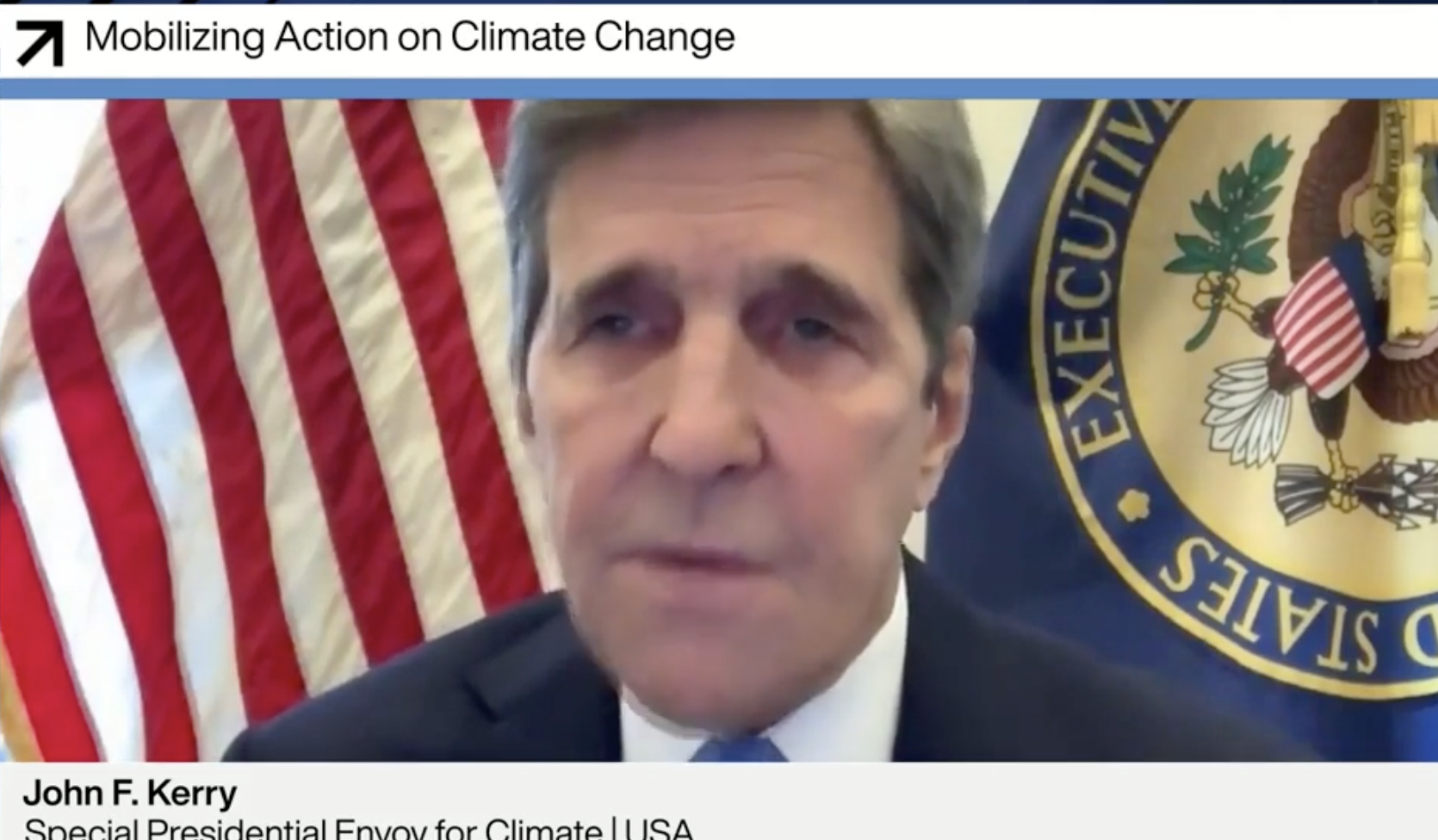 Speaking at the Davos World Economic Forum, US Climate Envoy John Kerry offered a strong critique of natural gas: “Gas is primarily methane, and we have a huge methane problem, folks.”
Kerry was responding to Shell CEO Ben van Breundel’s argument that the US government should reduce demand for fossil fuels and not take action to reduce production by companies like Shell.
UN Deputy Secretary General Amina Mohammed offered an even more blunt criticism of van Breundel’s argument that we can drill our way out of global warming: “You can’t be talking about new [fossil-fuel exploration and production], when the science tells you have to reduce that production 6 percent per annum and you’re increasing by 2 percent.”
Biden Administration Staffs Up With Climate Hawks: Department of Energy
The Department of Energy has announced numerous senior hires, the vast majority of whom are climate hawks. As with the transition team, the picks range from lifelong environmental justice activists to corporate technologists. Most but not all have previous administration experience.
Former Michigan governor Jennifer Granholm is the nomineee to be Secretary of Energy. David G. Huizenga will serve as Acting Secretary of Energy, and Richard Glick is becoming chair of the Federal Energy Regulatory Commission.
Energy
- Shalanda H. Baker, Deputy Director for Energy Justice. Shalanda H. Baker was mostly recently a professor of law, public policy, and urban affairs at Northeastern University. She was the co-founder and co-director of the Initiative for Energy Justice, which provides technical law and policy support to communities on the front lines of climate change. Baker served as an Air Force officer prior to her honorable discharge pursuant to the then existing “Don’t Ask, Don’t Tell” policy, and became a vocal advocate for repeal of the policy. She earned a B.S. in Political Science from the U.S. Air Force Academy, a J.D. from Northeastern University, and L.L.M. from the University of Wisconsin.
- Robert Cowin, Deputy Assistant Secretary for Public Engagement. Robert Cowin was most recently director of government affairs for the Climate & Energy program at the Union of Concerned Scientists. Prior to that, Cowin worked for the National Environmental Trust, where he helped organize national campaigns focused on climate change, clean energy, and clean air. He holds a master’s degree in international relations from the Fletcher School of Law and Diplomacy at Tufts University, and a B.A. from Boston College.
- Tanya Das, Chief of Staff, Office of Science. Tanya Das was most recently a Professional Staff Member on the U.S. House Committee on Science, Space, and Technology, where she worked on legislation on a range of issues in clean energy and manufacturing policy. She was an AAAS Congressional fellow in the Office of Senator Chris Coons. She earned her Ph.D. in Electrical Engineering from the University of California, Santa Barbara, and her B.S. in Electrical Engineering from the University of Michigan, Ann Arbor.
- Christopher Davis, Senior Advisor to the Secretary of Energy. Christopher Davis served all eight years of the Obama Administration — first in the White House Office of Legislative Affairs and then in several senior roles at the Department of Energy. Prior to that, he worked for the U.S. House Committee on Oversight and Reform and the U.S. House Committee on Energy and Commerce. More recently, Davis worked with Co-Equal, a non-profit organization providing expertise and knowledge to Congress on oversight and legislation.
- Ali Douraghy, Chief of Staff, Office of the Under Secretary for Science & Energy. Ali Douraghy was most recently Chief Strategy Officer for Lawrence Berkeley National Laboratory’s Earth & Environmental Sciences Area. He led the New Voices program at the National Academies of Sciences, Engineering and Medicine, which brings diverse leader perspectives into science policy. He received his Ph.D. in biomedical physics from the UCLA School of Medicine.
- Todd Kim, Deputy General Counsel for Litigation and Enforcement. Todd Kim most recently was a partner at Reed Smith LLP, and before that was the first Solicitor General for the District of Columbia, serving in that capacity more than 11 years. Kim was an appellate attorney for the U.S. Department of Justice, Environment and Natural Resources Division, and a clerk on the D.C. Circuit. Kim graduated magna cum laude from Harvard Law School, where he was an executive editor of the Harvard Law Review, and received his undergraduate degree magna cum laude in biology from Harvard College.
- Jennifer Jean Kropke, Director of Energy Jobs. Jennifer Jean Kropke served as the first Director of Workforce and Environmental Engagement for IBEW Local Union 11 and the National Electrical Contractors’ Association-Los Angeles’ Labor Management Cooperation Committee. She focused on creating clean energy, port electrification, and zero emission transportation opportunities for union members. She is a graduate of the UCLA School of Law.
- Andrew Light, Principal Deputy Assistant Secretary for International Affairs. Andrew Light has worked on international climate and energy policy in and outside of government for the last 15 years. From 2013 to 2016, he served as Senior Adviser and India Counselor to the U.S. Special Envoy on Climate Change, as well as a climate adviser in the Secretary of State’s Office of Policy Planning. Light was an international climate and energy policy volunteer for the Biden campaign and was one of the chief architects of Governor Jay Inslee’s plan for global climate mobilization. He is an environmental philosopher and is married to Washington Post reporter Juliet Eilperin. He completed his undergraduate work at Mercer University and doctoral work at the University of California, Riverside with a three-year post-doctoral fellowship in environmental risk assessment at the University of Alberta.
- David A. Mayorga, Director of Public Affairs. David A. Mayorga most recently served as Director of Communications for the Attorney General for the District of Columbia Karl A. Racine. Previously he was Senior Spokesperson for the Consumer Financial Protection Bureau and led communications for DOE’s Solar Energy Technologies Office, with the SunShot Initiative. He earned a B.A. from the University of Florida and began his professional career at the U.S. House Committee on Science.
- Shara Mohtadi, Chief of Staff, Office of Energy Efficiency & Renewable Energy. Shara Mohtadi has focused her career advising policymakers and international organizations on mitigating climate change and advancing clean energy policies. She most recently led the America’s Pledge initiative and managed grants focused on the coal to clean energy transition in Asia and Australia at Bloomberg Philanthropies. Previously, Shara served as a senior advisor on climate and energy policy for New York State government. During the Obama Administration, Mohtadi served as an advisor for the energy and environment portfolio at the White House, in the Office of Management and Budget. She received her undergraduate and graduate degrees from Columbia University.
- Tarak Shah, Chief of Staff. Tarak Shah is an energy policy expert who has spent the last decade working on combating climate change. At the Biden-Harris Transition, Shah was the Personnel lead for the Climate and Science team. From 2014-2017, he served as Chief of Staff to the Under Secretary for Science and Energy at DOE. Shah has also worked on political campaigns, including President Obama’s Senate and presidential campaigns. He received his undergraduate degree from the University of Illinois and his M.B.A from Cornell University.
- Kelly Speakes-Backman, Principal Deputy Assistant Secretary for Energy Efficiency & Renewable Energy. Kelly Speakes-Backman most recently served as the first CEO of the Energy Storage Association, the national trade organization for the energy storage industry. Speakes-Backman has spent more than 20 years working in energy and environmental issues in the public, NGO and private sectors. In 2019, she was honored by The Cleanie Awards as Woman of the Year.
- Narayan Subramanian, Legal Advisor, Office of General Counsel. Narayan Subramanian was a Visiting Research Fellow at the Center for Law, Energy, & the Environment at Berkeley Law leading a project tracking regulatory rollbacks, and served as a Fellow at the Initiative for Sustainable Energy Policy at Johns Hopkins University and Data for Progress. He was lead coordinator of the Elizabeth Warren presidential campaign’s climate and energy policy advisory group. Subramanian holds a J.D. from Columbia Law School, an M.P.A. from the School of Public & International Affairs at Princeton University, and a B.S. in Earth & Environmental Engineering from Columbia University.
- Shuchi Talati, Chief of Staff, Office of Fossil Energy. Dr. Shuchi Talati was most recently a Senior Policy Advisor at Carbon180 where she focused on policies to build sustainable and equitable technological carbon removal at scale. She also served as a policy volunteer on the Biden-Harris campaign. She was a UCS Fellow on solar geoengineering research governance and public engagement with the Climate & Energy program at the Union of Concerned Scientists. Dr. Talati earned a B.S. from Northwestern University, an M.A. from Columbia University, and a Ph.D. from Carnegie Mellon University. Her doctoral research focused on the climate-energy-water nexus looking specifically at the impacts of domestic climate regulations and carbon capture and storage technology.
- Jennifer Wilcox, Principal Deputy Assistant Secretary for Fossil Energy. Jennifer Wilcox is a direct carbon air capture expert. She was most recently the Presidential Distinguished Professor of Chemical Engineering and Energy Policy at the University of Pennsylvania, and a Senior Fellow at the World Resources Institute. Wilcox’s work examines the nexus of energy and the environment, developing strategies to minimize negative climate impacts associated with society’s dependence on fossil fuels. Wilcox holds a Ph.D. in Chemical Engineering and M.A. in Chemistry from the University of Arizona and B.A. in Mathematics from Wellesley College.
- Avi Zevin, Deputy General Counsel for Energy Policy. Avi Zevin is an attorney with experience advancing policies that enable the provision of carbon-free, reliable, and cost-effective electricity. Until joining the administration, he was energy policy counsel for Google. He was a senior attorney and Affiliated Scholar at the Institute for Policy Integrity at New York University School of Law and an attorney at Van Ness Feldman LLP. He was a policy advisor for the corporate-funded Third Way think tank from 2008 to 2009. Zevin holds a J.D., magna cum laude, from New York University School of Law, an M.P.A. from the Harvard Kennedy School of Government, and a B.A., with high honors, from the University of California, Berkeley.
Additional hires without significant reputation as climate policy experts or advocates include:
- Vanessa Z. Chan, Director, Office of Technology Transitions (Chief Commercialization Officer). Vanessa Z. Chan comes to the Biden-Harris Administration from the University of Pennsylvania where she was the Brassington Professor of Practice and the Undergraduate Chair of the Materials Science and Engineering Department. She has spent the past 20 years helping large companies commercialize their technologies and revamping the academic curriculum of engineering students to make a greater social impact. Dr. Chan is a former longtime McKinsey & Company partner. She is a Venture Board Director for Vanguard and United Technology Corporation and a board member at multiple start-ups. Dr. Chan was the first woman and the first East Asian elected partner in McKinsey’s North American Chemicals practice. She is married to Mark van der Helm, the head of Energy, Waste and Facilities Maintenance at Walmart. Chan earned her Ph.D. in Materials Science and Engineering from the Massachusetts Institute of Technology and a B.S. in Engineering from the University of Pennsylvania.
- Caroline Grey, White House Liaison. Caroline Grey worked for Biden for President as Expansion States Director, managing distributed engagement in 33 states. Previously, she worked on the presidential campaign of Senator Elizabeth Warren. Grey started her career as an organizer for then-Senator Barack Obama’s 2008 presidential campaign and worked on the 2012 Obama re-election campaign. She co-founded Civis Analytics, a data science firm.
- Ali Nouri, Principal Deputy Assistant Secretary for Congressional and Intergovernmental Affairs. Ali Nouri is a molecular biologist and most recently was the President of the Federation of American Scientists, which addresses global health and security risks. In the past year, he has been working aggressively to fight COVID-19 misinformation. Prior to that, he served as a U.S. Senate staffer for a decade for Sens. Jim Webb and Al Franken and served as an advisor in the office of then UN Secretary General Kofi Annan. Nouri obtained a B.A. in biology from Reed College and received his Ph.D. from Princeton University.
In 1957, Climate Scientist Warned Congress That Fossil-Fueled Global Warming Could Turn California Into A Desert

Dr. Roger Revelle (seated, far right) testifies before Congress, May 1, 1957. (Roger Revelle papers, UCSD)
Unprecedented heat and wildfires driven by fossil-fueled global warming are ravaging the forests of California and the Pacific Northwest – in line with scientific predictions to the U.S. Congress from the 1950s.
Over sixty-three years ago, physical oceanographer Roger Revelle testified to Congress that fossil-fueled climate change could turn southern California and most of Texas into “real deserts.”
On May 1, 1957, Dr. Revelle testified at the hearing on appropriations for the International Geophysical Year, Independent Offices Subcommittee, House Committee on Appropriations:
The last time that I was here I talked about the responsibility of climatic changes due to the changing carbon dioxide content of the atmosphere and you will remember that I mentioned the fact that during the last 100 years there apparently has been a slight increase in the carbon dioxide because of the burning of coal and oil and natural gas.If we look at the probable amounts of these substances that will be burned in the future, it is fairly easy to predict that the carbon dioxide content of the atmosphere could easily increase by about 20 percent. This might, in fact, make a considerable change in the climate. It would mean that the lines of equal temperature on the earth would move north and the lines of equal rainfall would move north and that southern California and a good part of Texas, instead of being just barely livable as they are now, would become real deserts.
Atmospheric carbon dioxide concentrations in 1957 were 315 parts per million. It reached 378 ppm, Revelle’s cautioned 20 percent increase, in 2004.
In 2015, California Gov. Jerry Brown announced the state’s first-ever mandatory water use restrictions.
As of September 2020, the planet is now at 410 ppm, a 30 percent increase.
Revelle’s testimony in the previous year in support of federal funding to monitor atmospheric and oceanic carbon dioxide levels was the first time that manmade global warming was discussed in the Congressional record.
“We are making perhaps the greatest geophysical experiment in history,” he said on March 8, 1956, “an experiment which could not be made in the past because we didn’t have an industrial civilization and which will be impossible to make in the future because all the fossil fuels will be gone.”
Revelle also noted that regional shifts in climate in the past led to “the rise and fall and complete decay of many civilizations.”
In response to questions from Rep. Sydney Yates (D-Ill.) and Rep. Albert Thomas (D-Texas), Dr. Revelle elucidated further:
People talk about making fresh water out of sea water. God does that for them far better than any man ever could. He evaporates three feet of water on every square foot of the ocean every year. The problem is that the distribution system is bad. The water coming from the ocean moves over the land but mostly over the northern and southern parts of the land, and this circulation pattern, or transport of water vapor from the sea to the land and the precipitation on the land, apparently shifts with the temperature; at least we think it does, and there seems to be a broad belt called the horse latitudes between the equatorial regions and the belt of cyclonic storms where the precipitation is minimal.If you increase the temperature of the earth, the north latitude belt, which covers most of the western part of the United States and the Southwest, would move to the north.
“Only God knows whether what I am saying is true or not,” Revelle concluded. But his understanding of the science of fossil-fueled global warming has now been proven correct. The climate of southern California has undergone a phase shift to a persistently hotter, drier regime — a permanent shift if action is not taken to end the burning of fossil fuels and reduce the concentration of industrial greenhouse pollution in the atmosphere.
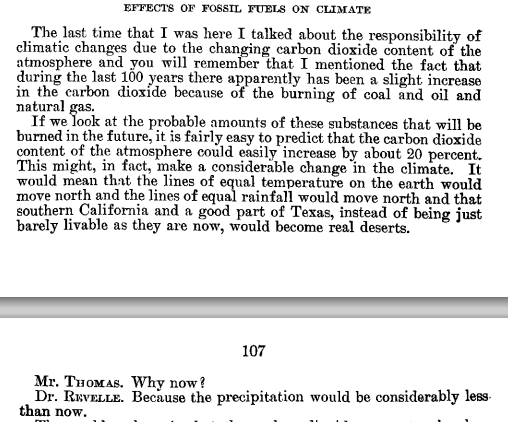
Transcript of Revelle’s testimony, under the heading “EFFECTS OF FOSSIL FUELS ON CLIMATE”
Top Hurricane Scientist: ‘Katrina Would Not Have Been As Intense In 1980′
Originally published September 5, 2008 on the ThinkProgress Wonk Room.
Massachusetts Institute of Technology climatologist Kerry Emanuel says that he would be “surprised” if global warming “were not a big factor” in intensifying Hurricane Katrina’s destructive power. Katrina, the costliest and third deadliest hurricane in United States history, intensified to Category Five strength, with peak sustained winds over 170 mph, over extremely warm waters in the Gulf of Mexico before its record storm surge devastated the Gulf Coast.
Emanuel compared the meteorological conditions in which Hurricane Katrina developed in 2005 to the existing conditions twenty-five years earlier in 1980. Using his model of tropical storm potential intensity, which uses at determining factors such as sea and air temperature and wind shear, he found that Katrina would have been significantly weaker twenty-five years earlier. When asked how to characterize his findings, Emanuel replied:
I think it is correct to say that Katrina would not have been as intense in 1980. What part of that to attribute to global warming is tricky, but I would be surprised if it were not a big factor.
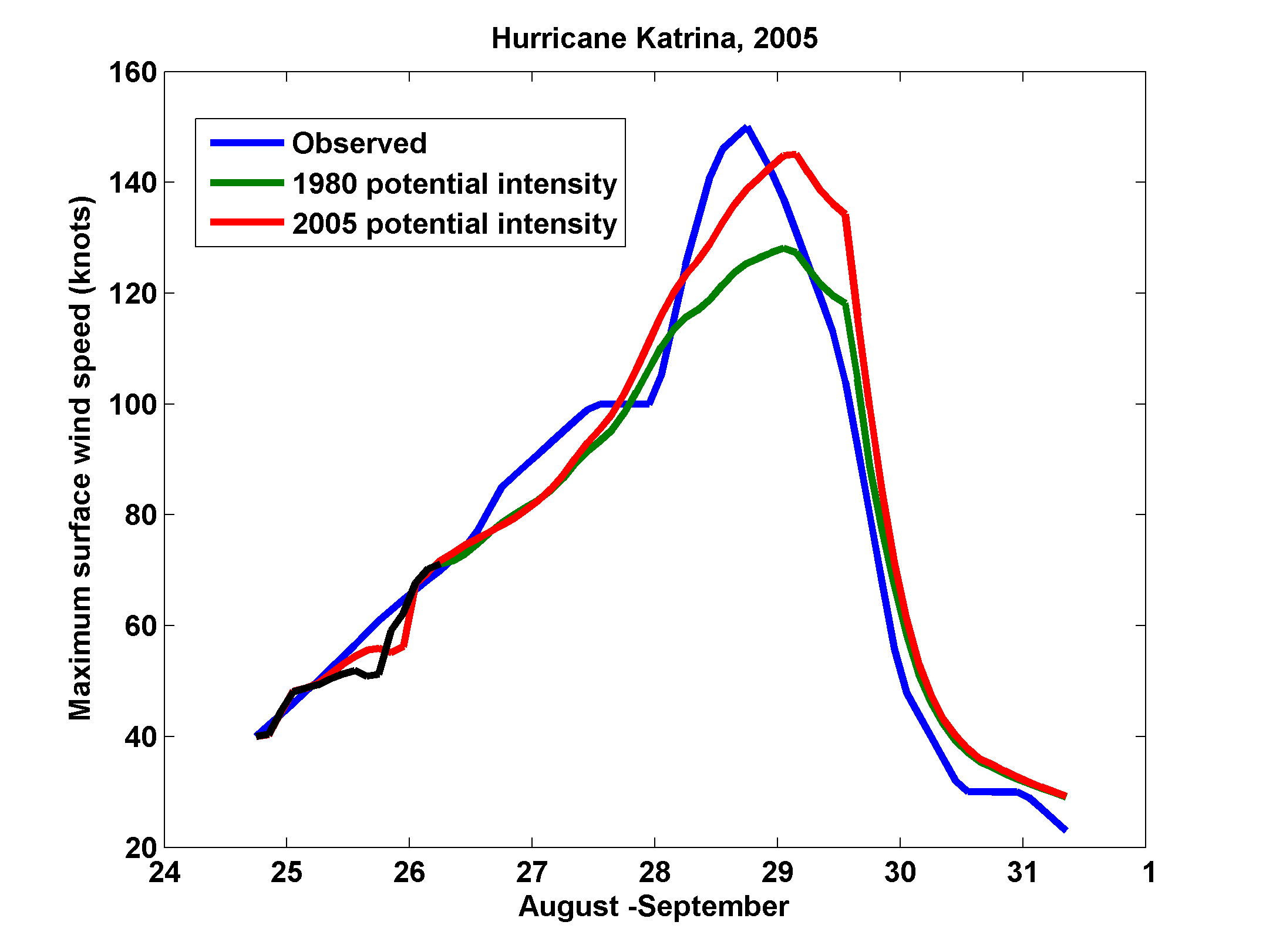 |
| NCEP/NCAR Re-analysis potential intensity for 1980 and 2005 (Emanuel, 2008) |
Dr. Emanuel, one of Time Magazine’s 100 Influential People of 2006, is the author of dozens of influential papers on tropical meteorology and climatology, including the 2005 Nature paper, “Increasing destructiveness of tropical cyclones over the past 30 years.” Dr. Emanuel has authored the popular science books Divine Wind: The History and Science of Hurricanes and What We Know About Climate Change, and is profiled in ScienceProgress editor Chris Mooney’s book, Storm World: Hurricanes, Politics, and the Battle Over Global Warming.
Examining the Oil Industry’s Efforts to Suppress the Truth about Climate Change
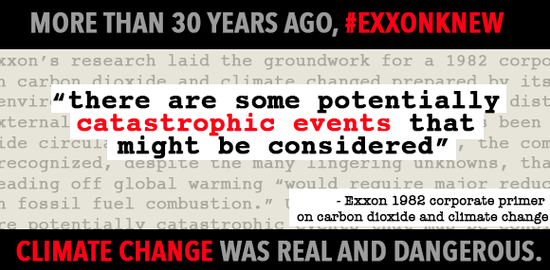 The Subcommittee will examine how the oil industry’s climate denial campaign has negatively and disproportionately affected people of color and vulnerable populations in our country and around the world, as well as drowned out the voices of everyday Americans.
BACKGROUND
Decades of climate denialism by the oil industry forestalled meaningful government action to avert the current crisis. As early as the 1960s, oil giants like Exxon knew that climate change was real and that the burning of fossil fuels was a major contributor to the problem.
The lack of government action on climate change has a disproportionate impact on vulnerable communities who are often harmed “first and worst” by climate change.
Climate denial not only led to these devasting effects on vulnerable populations; it also represents a distortion of our democracy, as powerful, moneyed interests control the conversation and drown out the voices of average Americans who are paying the price of climate change.
Despite efforts to rehabilitate their image by pledging to stop supporting think tanks and lobbyists who promote climate denialism, Exxon has continued to fund climate deniers. Exxon still continues to fund organizations “steeped in climate denial and delay” to this day, clear evidence that it has not changed since its initial pivot from climate science to denial.
Despite the already devasting effects of climate change, Exxon shows no signs of slowing down on its production of fossil fuels. To the contrary, Exxon and other oil companies continue to explore for more oil, meaning they are not taking the problem of climate change or the development of alternative fuels seriously.
Witnesses:- Dr. Mustafa Ali, Vice President, Environmental Justice Climate and Community Revitalization, National Wildlife Federation
- Dr. Ed Garvey, Former Exxon Scientist
- Dr. Martin Hoffert, Former Exxon Consultant, Professor Emeritus, Physics, New York University
- Dr. Naomi Oreskes, Professor, History of Science, Affiliated Professor, Earth and Planetary Sciences, Harvard University
- Sharon Eubanks, Esquire, Of Counsel, Henderson Law Firm, PLLC
WOW 101: The State of Wildlife
Chair Jared Huffman opening statement:
Welcome to the Water, Oceans, and Wildlife subcommittee 101 hearing on the state of wildlife. So far, we’ve talked about the state of our water supplies, the state of our oceans, and now it’s time to talk about wildlife.
Our topic today is especially fitting because it is National Wildlife Week. This week celebrates the anniversaries of several important events in the preservation of our nation’s wildlife, including the establishment of the first National Wildlife Refuge, Pelican Island, in 1903; the Duck Stamp Act of 1934; and the founding of the US Fish and Wildlife Service in 1940. For over a century, Americans have expected that their representatives work together to protect wildlife. And that’s because our experiences with nature and wildlife are fundamental to our cultures, our families, and our way of life. Maybe you go hunting or fishing with your family, maybe your kids watch the birdfeeder in the backyard, or maybe you’ve visited our national parks and wildlife refuges and seen all the wild beauty that our country has to offer. I, for one, get out as much as possible in my district to fish. There are few things better than a relaxing day spent fishing at a quiet spot on the North Coast of California.
I think it’s safe to say that we all want to protect native wildlife, both for the sake of wildlife itself and for us and future generations to enjoy. In fact, 4 out of 5 Americans support the Endangered Species Act and protecting species. We also share the goal of helping endangered wildlife around the globe, whether it is elephants, rhinos, tigers, polar bears, whales, or pandas.
Although we come from different states, with different landscapes and regional issues, the goal of today’s hearing is to get a clear and fact-based overview of the state of wildlife. Unfortunately, what I know so far, and what our expert witnesses will likely tell you, is that the state of many species in this country and across the globe is dire. In the history of the planet, there have been 5 major extinctions of life on Earth, including the time a meteor wiped out the dinosaurs. While you may not see a meteor falling from outer space or volcanoes filling the skies with ash right now, scientists have determined that we are in the middle of a sixth mass extinction.
And the truth is, it’s because of us. Human activity has destroyed all kinds of habitat, polluted our water and air, and is changing the climate in ways that many species of wildlife are struggling to keep up with. If we don’t do something about climate change, scientists predict that 1 in 6 species could face extinction.
However, it’s completely in our ability to solve these problems. There are several legislative proposals to protect wildlife that have been put forward by members of this Congress. We plan to hold legislative hearings soon to get many of these bills moving. We will also be conducting oversight of this administration, which we’ve seen place industry interests above those of the American people over and over again, including protecting wildlife and outdoor recreation.
Just last week, we held a hearing on the many threats facing one of the most endangered whales alive today, the North Atlantic right whale. Catering to oil and gas companies, the Trump administration has decided to increase the stressors facing this already imperiled species, even in the face of opposition from local communities and states.
The Endangered Species Act is another top target for the Trump administration. The administration is currently finalizing rules that would create loopholes in the law, putting more species at risk of extinction and giving more leeway to industry. We expect the administration to release the final rules any day now. The Trump administration is also undermining protections for wildlife in the Arctic National Wildlife Refuge, one of the last remaining pristine habitats on Earth, by opening it up to oil and gas drilling. Over 700 species of plants and animals call the Arctic National Wildlife Refuge home, including polar bears, wolves, and the Porcupine caribou herd, which the Gwich’in people have relied on for time immemorial. I introduced the Arctic Cultural and Coastal Plain Protection Act to restore protections for the Arctic National Wildlife Refuge and urge my colleagues to join over one hundred other Members of Congress in supporting the bill.
The Trump administration announced last year that “incidental take” under the Migratory Bird Treaty Act would no longer be interpreted as prohibiting the incidental killing of birds. And guess who benefits? You guessed it: oil and gas companies. Finally, the quality of key habitats that promote recreation, hunting, and fishing, as well as access to these habitats, are being eroded by the administration’s energy-dominance policy. As you can see, there is a clear pattern here. And unfortunately, the list goes far beyond these few instances I’ve described today. So this Congress, this committee has a lot of work to do – making sure we hold this administration accountable for decisions that further threaten wildlife and putting new, innovative ideas forward to address the sixth mass extinction. We’re going to hear from a great panel of wildlife experts today. Thank you all for being here. I now invite the Ranking Member for his remarks, and then we will welcome and introduce our witnesses.
Majority witnesses- Jamie Rappaport Clark, President and Chief, Executive Officer, Defenders of Wildlife
- Dan Ashe, President and Chief Executive, Officer, Association of Zoos & Aquariums
- Christy Plumer, Chief Conservation Officer, Theodore Roosevelt Conservation Partnership
- Valerie Covey, Commissioner, Precinct Three, Williamson County Commissioner’s Court, Georgetown, TX
- Rodger D. Huffman, President, Union County, Oregon Cattlemen’s Association
The Denial Playbook: How Industries Manipulate Science and Policy from Climate Change to Public Health
The Oversight and Investigations Subcommittee planned to hold a Feb. 26 hearing titled The Denial Playbook: How Industries Manipulate Science and Policy from Climate Change to Public Health. Witnesses at the hearing – part of the Natural Resources Committee’s historic month-long series of hearings on climate change – will speak to the tactics used by various industries to mislead the public about health and environmental risks and explain how to recognize the signs of a denialist misinformation campaign in any field.
However, as the hearing began with two Democrats and four Republicans present, Rep. Louie Gohmert (R-Texas) was able to call the hearing out of order. The testimony continued as a forum.
Majority Witnesses
- Chris Borland, Retired NFL player. Chris Borland is a former linebacker for the San Francisco 49ers of the National Football League. He retired early from a successful career because of concerns about chronic traumatic encephalopathy, a neurological condition caused by repeated blows to the head and body experienced by professional, college, and early age football players.
- Mr. Ryan Hampton, Founder, Voices Project. Ryan Hampton is a national addiction recovery advocate and person in sustained recovery from 10 years of active opioid use. He has worked with multiple non-profits and community organizing campaigns—including the nation’s top addiction recovery advocacy organizations.
- Ms. Alexandra Precup. Ms. Precup is a native of Puerto Rico who was displaced by Hurricane Maria. She will speak to the effects of climate change on her and her family.
- Dr. David Michaels, Professor, Department of Environmental and Occupational Health, George Washington University. Dr. Michaels is the former Assistant Secretary of Labor for Occupational Safety and Health. He is among the nation’s top experts in disinformation campaigns, including climate denial, and will speak to the ways in which denial campaigns across industries share similar recognizable traits.
Sens. Heidi Heitkamp and Patrick Leahy Oppose Trump USDA Chief Scientist Nominee Sam Clovis
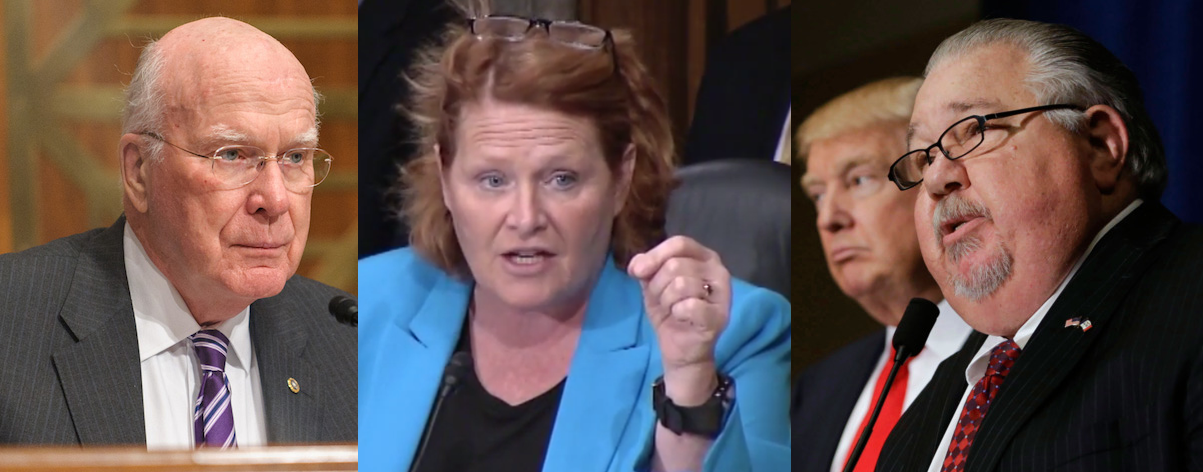 Two more members of the Senate Committee on Agriculture, Senator Patrick Leahy, Democrat of Vermont, and Senator Heidi Heitkamp, Democrat of North Dakota, are publicly opposing the confirmation of Sam Clovis, Trump’s nominee to be USDA chief scientist. Ranking Member Debbie Stabenow of Michigan announced her opposition in September.
Clovis, long under criticism for his lack of scientific credentials, is now embroiled in the Mueller investigation for his role as a top Donald Trump presidential campaign official. Clovis directed his subordinate on the Trump campaign, George Papadopoulos, to “make the trip” to Moscow to collude with Russian agents.
“If his anti-science record were not enough cause for concern,” Leahy’s statement reads, “the latest reporting suggesting that Mr. Clovis may have facilitated Russian collusion in our elections raises these concerns to an alarming level. Even for this administration, that should be disqualifying.”
“Sam Clovis is uniquely unqualified to serve as USDA’s top scientist, and his confirmation would be harmful to North Dakota’s farmers, ranchers, and rural communities,” Heitkamp said in a statement to Politco. “North Dakota’s farmers and ranchers need and deserve someone in this role who will work in their best interest – and that is not Sam Clovis. I’ll oppose his nomination.”
With Leahy and Heitkamp’s announcements, there are ten senators, including three on the Agriculture Committee, to publicly oppose the nominee, who rejected the science of climate change, promoted the conspiracy theory that Barack Obama was not born in the United States, and argued that homosexuality is a choice.
A growing coalition of environmental, science, and sustainable farming organizations oppose Clovis.
Senators in public opposition to Sam Clovis:Members of the agriculture committee are marked with an asterisk.
Linda McMahon, Trump's SBA Pick, Rejects Climate Science
World Wrestling Entertainment executive and performer Linda McMahon, Donald Trump’s nominee to head the Small Business Administration, is a global warming denier.
When McMahon unsuccessfully ran for U.S. Senate in Connecticut in 2010, she explained her rejection of the scientific understanding of climate change to the Connecticut Mirror:McMahon, the Republican nominee and former CEO of World Wrestling Entertainment, says the “science is mixed” on what has caused global warming, although she does not dispute that the climate is indeed changing.“I just don’t think we have the answers as to why it changes,” she said. “I’m not a scientist, so I couldn’t pretend to understand all the reasons. But the bottom line is we really don’t know.”
McMahon went on to describe her opposition to climate legislation and support for unrestricted oil and gas drilling. She lost to Democrat Richard Blumenthal, who accurately stated that “the science is irrefutable, and we would be irresponsible to ignore it.”
In reality, the carbon-dioxide greenhouse effect is a physical fact known since the 1800s. The only scientifically plausible systematic explanation – what the word “theory” means in scientific jargon, despite Rep. Perry’s confusion – for the rapid warming of the planetary climate since 1950 is industrial greenhouse pollution. Because of the hundreds of billions of tons of industrial carbon dioxide added to the atmosphere, the global climate is continuing to warm, with every decade since the 1970s warmer than the last, and the impacts of global warming are accelerating faster than scientists projected.