Hydrogen Hype's Physics Problem
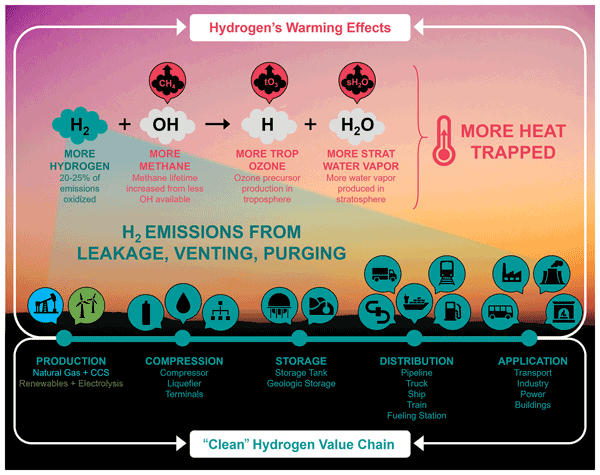 The Biden administration is spending billions on the National Clean Hydrogen Strategy, even recently celebrating Hydrogen Day on October 8 (because hydrogen’s atomic weight is 1.008) to “mark a symbolic opportunity to celebrate hydrogen—clean hydrogen, specifically—and the crucial role this element plays in supporting a robust, equitable clean energy future for all Americans.”
“There’s a lot to like about hydrogen as a fuel source, climate journalists such as David Gelles gush.
The only problem is that “clean hydrogen,” also known as “green hydrogen”—that is, hydrogen gas generated using renewable electricity—isn’t particularly “clean” or “green,” although it’s less polluting than “gray” and “blue” hydrogen, produced from natural gas.
Unfortunately, even “green” hydrogen is a powerful greenhouse pollutant.
As an important paper from Environmental Defense Fund scientists Ilissa Ocko and Steven Hamburg explains, hydrogen is unavoidably leaky, because it’s such a small molecule, and like methane, has a high short-term warming effect. In fact, one of hydrogen’s main warming effects is to increase the atmospheric lifetime of methane. Methane breaks down in contact with the hydroxyl (OH) radical formed when ultraviolet light interacts with ozone (O₃) and water vapor (H₂O). Hydroxyl also reacts with hydrogen molecules (H₂), so significant hydrogen pollution means atmospheric methane doesn’t break down. Thus, Ocko and Hamburg find:
Hydrogen’s 100-year greenhouse warming potential (GWP) is twice as high as previously thought, and its 20-year GWP is 3 times higher than its 100-year GWP. Hydrogen’s maximum GWP occurs around 7 years after the initial pulse of emissions, with a range of 25 to 60 based on uncertainties, and a central estimate of 40.
In short, “green” hydrogen isn’t.
Plastics and Human Health: Understanding the Risks
Sen. Jeff Merkley (D-Ore.) presents findings of the new report from the Mindaroo-Monaco Commission on Plastics and Public Health.
Please join for a briefing to review the findings of the new report on the impacts of plastics on human health. The authors of the report will describe the health and environmental implications of plastic at every stage of its lifecycle, including recommendations for the United Nations Global Plastics Treaty.
Thursday, April 27th, 2:00pm ET 406 Dirksen Senate Office Building
ARPA-E Energy Innovation Summit: Day Three

The ARPA-E Energy Innovation Summit (The Summit) is an annual conference and technology showcase that brings together experts from different technical disciplines and professional communities to think about America’s energy challenges in new and innovative ways. Now in its thirteenth year, the Summit offers a unique, three-day program aimed at moving transformational energy technologies out of the lab and into the market.
The summit is taking place at the Gaylord National Resort & Convention Center, National Harbor, Maryland.
Agenda: Day One | Day Two | Day Three
| 9:00 a.m. – 10:00 a.m. | Energy and the Blue Economy: Emerging Technology Needs and Market Opportunities | ||||||||||||||||||||||||||||||||||||||||||||
|---|---|---|---|---|---|---|---|---|---|---|---|---|---|---|---|---|---|---|---|---|---|---|---|---|---|---|---|---|---|---|---|---|---|---|---|---|---|---|---|---|---|---|---|---|---|
This “Energy and the Blue Economy” discussion will bring together representatives from across government, philanthropy, and ocean-based industries, who are all anticipated to drive significant growth in at-sea energy consumption over the coming decade. The panel will serve to connect the ARPA-E community to these diverse users of ocean energy technologies, whose operational requirements will motivate the development of innovative solutions in renewable marine energy generation, storage, and transfer. Discussion topics will include a) current marine energy technology limitations that could be overcome through focused development supported by ARPA-E; b) current and emerging Blue Economy markets that may offer high-risk, but high-growth potential for novel energy technologies; c) shared energy technology requirements across the many segments of the Blue Economy; and d) unique challenges and opportunities for funding and scaling energy technologies for use in ocean environments. Ultimately, this discussion will highlight the role that ARPA-E and its performers, in addition to the DOE at large, can have in supporting the energy needs of growing the Blue Economy, potentially illuminating new markets, novel sources of investment, and untapped technology development spaces.
| 9:00 a.m. – 10:00 a.m. | Scaling up with SCALEUP
|
Scaling up a start-up or small business presents multiple challenges. This is particularly true when commercializing hard engineering technologies due to the investment required to demonstrate cost and performance at commercial scale sufficient to address market adoptions risks. Through the SCALEUP program, first launched in 2019, ARPA-E has endeavored to help address these challenges and accelerate deployment of promising technologies previously funded by ARPA-E. In this panel you will hear from leaders of a few of the companies from the SCALEUP 2019 and 2021 cohorts. They will describe some of the key technical, commercial, and team development challenges they have confronted – and continue to confront – in their scale-up journey and how they are addressing them.
| 9:00 a.m. – 10:00 a.m. | DOE Foundations
|
The Department of Energy has been tasked with setting up an independent foundation — the Foundation for Energy Security and Innovation (FESI) — per section 10691 of the CHIPS Act. FESI will be established as a non-profit 501©(3) organization. This panel will feature established organizations by other government departments. Attendees can gain an understanding of this new organization as panelists discuss what successes the department and organizations have created and how outside stakeholders interact with existing foundations.
| 10:25 a.m. – 10:30 a.m. | Video Address
| 10:30 a.m. – 10:35 a.m. | Video Address
| Martin Heinrich, U.S. Senate, New Mexico
| 10:35 a.m. – 10:45 a.m. | Keynote Address
| 10:45 a.m. – 11:00 a.m. | Keynote Address
| 11:00 a.m. – 11:25 a.m. | Fireside Chat
|
| 11:25 a.m. – 11:30 a.m. | Student PITCHES (Proposing Ideas for Technologies that Can Harness Energy Sustainably)
|
| 11:30 a.m. – 11:35 a.m. | Keynote Address
|
| 11:35 a.m. – 11:40 a.m. | Keynote Address
|
| 11:40 a.m. | Closing Remarks
|
| |
Unleashing American Power: The Development of Next Generation Energy Infrastructure
This hearing will serve as a legislative hearing for three bills that would authorize research, development, and demonstration activities carried out or supported by the U.S. Department of Energy in the areas of grid security, hydrogen, and pipelines. Attached are discussion drafts of bills under consideration.
Opening Statements:- Subcommittee Chairman Brandon Williams
- Chairman Frank Lucas
- Spencer Nelson, Managing Director – Research and New Initiatives, ClearPath
- Dr. Richard Boardman, Directorate Fellow, Idaho National Laboratory, Energy and Environmental Science & Technology
- Cliff Johnson, President, Pipeline Research Council International
- Dr. Arvind Ravikumar, Co-Director, Energy Emissions Modeling and Data Lab Research Associate Professor, Department of Petroleum and Geosystems Engineering, the University of Texas at Austin
- Jason Fuller, Chief Energy Resilience Engineer, Pacific Northwest National Laboratory
ARPA-E Energy Innovation Summit: Day Two
The ARPA-E Energy Innovation Summit (The Summit) is an annual conference and technology showcase that brings together experts from different technical disciplines and professional communities to think about America’s energy challenges in new and innovative ways. Now in its thirteenth year, the Summit offers a unique, three-day program aimed at moving transformational energy technologies out of the lab and into the market.
The summit is taking place at the Gaylord National Resort & Convention Center, National Harbor, Maryland.
Agenda: Day One | Day Two | Day Three
| 9:00 a.m. – 10:00 a.m. | Fast Pitch: Nuclear & Materials | ||||||||||||||||||||||||||||||||||||||||||||||||||||||||||||||||||||||||||||
|---|---|---|---|---|---|---|---|---|---|---|---|---|---|---|---|---|---|---|---|---|---|---|---|---|---|---|---|---|---|---|---|---|---|---|---|---|---|---|---|---|---|---|---|---|---|---|---|---|---|---|---|---|---|---|---|---|---|---|---|---|---|---|---|---|---|---|---|---|---|---|---|---|---|---|---|---|---|
| 9:00 a.m. – 10:00 a.m. | Grid Storage Beyond the Hype
|
Intermittent resources such as wind and solar play a greater role in energy generation. Concurrently, consumer, commercial, and industrial power consumption increasingly electrifies. Energy storage will play a critical role in balancing supply and demand across the grid, regardless of time of day, weather, or season. This is reflected in the public funding and private capital flowing to the development of new battery and alternative energy storage technologies and projects. This panel will explore the role that storage currently plays in the grid and, more importantly, what to expect in the future, and when. Our panelists will discuss the technologies and the business cases behind recent high-profile long duration energy storage projects to provide an inside view into this key enabler of the energy transition.
| 9:00 a.m. – 10:00 a.m. | What’s Behind the Corporate Curtain?
|
This panel will examine large company absorption and adoption of companies and their technologies. When a company conducts an IPO or other type of capital raise, everything happens in the public eye. Conversely when one company acquires another’s technology – or the company itself – the process is opaquer and that technology sometimes doesn’t resurface for years, if ever. Large company executives will pull back the curtain and explain what happens to the energy technologies they acquire after the purchase and how they are absorbed or adopted into the acquirer’s operations. Learn more about this potential road to commercialization.
| 11:00 a.m. – 11:15 a.m. | Tech Demo: CHARGED: Commercialization of Highly Accelerated Reliable Grid-Networked Energy Delivery
| Team: Imagen Energy
| 12:00 p.m. – 1:00 p.m. | Tech Demo: Predictive Data-Driven Vehicle Dynamics and Powertrain Control: from ECU to the Cloud
| University of California, Berkeley (UCB)
| This NEXTCAR project seeks to reduce vehicle energy consumption by 30%, via connectivity and automation technologies. If scaled to all on-road vehicles in the U.S., these technologies potentially eliminate 4.5 quads of energy consumption. Our project pursues three use-cases. The first leverages communication with signalized intersections to automate the speed profile and lane changing to minimize energy consumption, in arterial roads. Second, we automate the parking and charging behaviors in parking lots via vehicle-to-vehicle and vehicle-to-infrastructure communication. Third, we minimize fleet vehicle energy consumption via optimized dispatching, routing, and charge scheduling in urban environments. We invite you to engage with us on scaling this technology to maximize impact. 10:30 a.m. – 12:00 p.m. | Student PITCHES (Proposing Ideas for Technologies that Can Harness Energy Sustainably)
|
Pitchers:
| 12:00 p.m. – 1:00 p.m. | American Energy Innovators Network: Designing Federal Policy for Energy Startups
| The American Energy Innovators Network (AEIN) is hosting a policy discussion for Summit participants. Join us for a brief overview of the policy landscape affecting clean energy startups, entrepreneurs, and investors, and discussion on policy priorities for the upcoming year. This conversation is open to anyone who is interested.
| 1:15 p.m. – 1:35 p.m. | Keynote Address
| 1:35 p.m. – 1:55 p.m. | Fireside Chat
|
| 1:55 p.m. – 2:05 p.m. | Keynote Address
|
| 2:15 p.m. – 2:30 p.m. | Keynote Address
|
* Dr. David Victor, Professor of Innovation and Public Policy, School of Global Policy and Strategy, University of California San Diego, BP
| 2:30 p.m. – 2:40 p.m. | Keynote Address
|
| 2:45 p.m. – 3:15 p.m. | Keynote Address & Fireside Chat
|
| 3:45 p.m. – 4:45 p.m. | Fast Pitch: Sustainability & Resilience
|
| 3:45 p.m. – 4:45 p.m. | Best Practices and Challenges for Product or Process Lifecycle Analyses
|
The focus on sustainability across multiple industry sectors has enhanced the need for the development of highly sophisticated Lifecycle Analysis (LCA) tools for revenue generating products and processes. These tools help companies estimate and reduce their Scope 1-3 emissions to meet the sustainability scorecards they have been mandated to report on. Development of such models are a non-trivial task requiring a comprehensive understanding of cradle-to-grave supply chains and acquiring and analyzing data sources, for accurate reporting. This panel session will focus on identifying some of the challenges and best practices for the development of LCA tools for the aviation, datacenter, oil & gas, and materials manufacturing industries and what transformational technologies are needed. Perspectives from the panelists will focus on what is possible versus what is needed and how the uptake of these tools for future decision making can be enhanced.
| 3:45 p.m. – 4:45 p.m. | Nuclear Power for our Low Carbon Future: Rethinking the Nuclear Waste Challenge
|
The energy transition will require a variety of low-carbon energy technologies and, while early in the transition, the premium for constant, on-demand power is becoming increasingly important. One option for low-carbon, baseload electricity is nuclear energy. Several advanced reactor companies are targeting deployment towards the latter part of this decade, though a common question relevant to their rapid deployment is, “What should we do about the waste?”. The current disposal plan, decided in the late 1970s and endorsed multiple times since, for nuclear waste is to permanently dispose of the material in a deep geological repository. However, the existing nuclear waste sits in interim storage at approximately 100 locations throughout the United States and the suitability of a potential deep geological repository to effectively sequester nuclear waste from advanced reactors is unclear. Fortunately, technologies, including waste forms, recycling, transmutation, etc., have dramatically evolved and the potential to reassess optimal disposal options is timely. This panel will discuss how potential technological innovations could have significant impact on the viability of various disposal options.
| 5:15 p.m. – 5:30 p.m. | Tech Demo: Analytics Data Hub and the Intelligence Potential of Clarivate’s Global Research & Innovation Data
| Clarivate Partner Demo
| 6:45 p.m. – 7:00 p.m. | Tech Demo: Compact Diffusion Bonded Printed-Circuit Heat Exchanger Development Using Nickel Superalloys for Highly Power Dense and Efficient Modular Energy Production Systems
| Vacuum Process Engineering (VPE) will present progress on the design and manufacturing development of compact diffusion bonded microchannel heat exchangers using high nickel superalloys. Microchannel heat exchangers are constructed from laminating layers of sheet metal together in a solid-state joining process where the sheet metal layers contain small semicircular channels to accommodate fluid flow with alternating flow paths. Typically, microchannel heat exchangers are constructed from stainless steel alloys which limits their operating conditions to ~650 °C at ~20 MPa. The development of alternative channel forming and bonding techniques developed in this project for high nickel alloys such as IN740H allow for the operating envelope of microchannel heat exchangers to be extended to 800 °C at 28 MPa. A prototype 5-kW heat exchanger constructed from IN740H and operated at temperatures above 800 °C will be presented.
| 7:30 p.m. – 7:45 p.m. | Tech Demo: AERIALIST – 2nd generation motor for lArge ElectRIc Aircraft propuLsIon SysTems
| Team: Wright Electric
| 5:00 p.m. – 6:45 p.m. | ARPA-E: The Team Transforming Energy
|
ARPA-E has a history of making a difference – not just in the way the United States uses energy, but also in the lives and careers of those who join the ARPA-E team. The Program Director, T2M Advisor, and Fellow positions can play a decisive role in a career both by providing the opportunity to revolutionize the energy sector and positioning team members for future prospects that may have otherwise been out of reach or unimagined. These positions are term limited to drive a consistent influx of new ideas and perspectives into the agency and grow its alumni network throughout the energy innovation community. Join new ARPA-E Director Dr. Evelyn Wang as she sits with a panel of ARPA-E team members and alumni to discuss their experience working at the agency, how they decided that a role at ARPA-E was the right fit for them, and how ARPA-E served as a pivotal point in their career trajectory.
| |
ARPA-E Energy Innovation Summit: Day One
The ARPA-E Energy Innovation Summit (The Summit) is an annual conference and technology showcase that brings together experts from different technical disciplines and professional communities to think about America’s energy challenges in new and innovative ways. Now in its thirteenth year, the Summit offers a unique, three-day program aimed at moving transformational energy technologies out of the lab and into the market.
The summit is taking place at the Gaylord National Resort & Convention Center, National Harbor, Maryland.
Agenda: Day One | Day Two | Day Three
| 10:00 a.m. – 10:15 a.m. | Opening Remarks & Keynote Address | ||||||||||||||||||||||||||||||||||||||||||||||||||||||||||||||||
| 10:15 a.m. – 10:50 a.m. | Fireside Chat
|
| 10:50 a.m. – 11:15 a.m. | Fireside Chat
|
| 11:15 a.m. – 11:35 a.m. | Keynote Address
|
| 11:35 a.m. – 11:55 a.m. | Fireside Chat
|
| 11:55 a.m. – 12:10 p.m. | Keynote Address
| Vinod Khosla, Khosla Ventures
| 11:45 a.m. – 1:45 p.m. | Government Agency Networking Program (GANP)
| The Government Agency Networking Program (GANP) at the annual ARPA-E Energy Innovation Summit provides an opportunity to meet with representatives from federal government agencies to discuss research interests, funding solicitations, grants, and other potential partnership opportunities.
| 2:00 p.m. – 3:00 p.m. | Fast Pitch: Batteries & Storage
|
| 2:00 p.m. – 3:00 p.m. | Lab to Impact: Maximizing Success with Technology Licensing Offices
|
In this panel, we will delve into best practices for how and when to engage with Technology Licensing Offices, and what common pitfalls to avoid. We will hear from a diversity of stakeholders representing an inventor, investor, lawyer, and licensing office, who will share their successes and failures – drawing from decades of experience. Whether you are looking to spin out a startup or license a technology, this panel will help provide practical takeaways on how to maximize success and impact.
| 2:00 p.m. – 3:00 p.m. | Prospects for Inertial Fusion Energy Given the Recent Achievement of Ignition at the National Ignition Facility
|
This panel will address the following questions about the prospects for inertial fusion energy (IFE): Can lasers be made efficient enough to enable a commercial IFE power plant? Can targets be made inexpensively and at scale? Are the physics challenges going from indirect drive (as is done on the National Ignition Facility) to direct drive (or another concept) tractable?
| 3:30 p.m. – 4:30 p.m. | Fast Pitch: Industrial Processes
|
| 3:30 p.m. – 4:30 p.m. | Decarbonizing the “Bus Stop” of the Future: Innovations in Urban Transportation
| As cities strive to reduce carbon emissions and improve urban transportation, defining the “bus stop” of the future, and with it, the necessary technology innovations and infrastructure, is becoming increasingly important. In high population density areas, where large metro systems are not available, the energy implications of the shift towards electrified and on-demand mobility options must be considered. Ride-hailing services currently optimize for pick-up proximity, but what does the equivalent approach for passenger transit look like in these situations and what role does energy efficiency need to play when the most convenient option is continued reliance on privately owned, personally driven cars? How does the increase in car sales during the pandemic further factor into future solutions? This thought-provoking panel will explore the disruptive innovations and flexible options that can address the energy consumption of future modes of urban transportation and tackle the question of how to ensure equity for all.
| 3:30 p.m. – 4:30 p.m. | Beyond VC: Alternative Funding Sources for Startups
| Panelists from a range of non-dilutive (federal, state and non-profit) and “less-dilutive” (venture debt, in various structures) funding sources will discuss how energy- and climate-tech startups can navigate non-traditional funding sources to best support their companies’ growth plans.
| 5:00 p.m. – 5:15 p.m. | Tech Demo: Advanced Operation & Maintenance Techniques implemented in the Xe-100 Plant Digital Twin to reduce Fixed O&M Cost
| X-energy is an Advanced Reactor design company and an awardee of the ARPA-E GEMINA Program. The main objective of the GEMINA Program is to demonstrate how Digital Twins can reduce Fixed Operations & Maintenance (O&M) costs for the Advanced Reactors (i.e. the Xe-100). X-energy’s 3D Immersive Digital Twin Experience demonstrates the integration between the physics-based Xe-100 Simulator and a 3D virtual representation of the Xe-100 plant. Users can walk through and interact with the Virtual Reality (VR) model as if it were the real Xe-100 plant. During the design phases of the Xe-100, the 3D model is being used for iterative design reviews to incorporate feedback, optimize layouts, and inform future work. During the operation phase of the Xe-100, the 3D model will be used for training of plant staff, particularly Maintenance crews. Combined with X-DATA™, X-energy’s Digital Twin product, the 3D Immersive Environment supports the implementation of “Central Maintenance” concepts that will ultimately lead to a safer, more reliable, and more economic nuclear plant for the 21st century.
| 5:45 p.m. – 6:00 p.m. | Tech Demo: Low-cost non-destructive plant root phenotyping
| Tomographic Electrical Rhizosphere Imager (TERI) is a technology aiming to make plant root phenotyping easier and faster. Root digging, washing, photographing, counting, and analysis have been the standard practice for field scale root phenotyping for a very long time. This is a process that is low throughput and very time and labor consuming. TERI aims to disrupt this practice to significantly accelerate plant root phenotyping at field scales to help accelerate the development of new root-superior plant varieties that are more resource efficient and climate resilient. TERI technology is based on the dialectic properties and behavior of plant root systems and can work under almost any type of soil, moisture, and plant species conditions. The lightweight of the hardware system and the user-friendly software interface make the system very easy to use by anyone without the technical background.
| 6:30 p.m. – 6:45 p.m. | Tech Demo: Basin-SCAN: Basin Scale Continuous oil and gas emissions mitigAtion Network
| Founded in 2018 through the ARPA-E MONITOR program, LongPath Technologies is the “5G” of methane measurement and abatement, providing a proven and standardized approach across the value chain. Our specialized laser systems detect, locate and quantify site-level emissions across 20+ square mile regions with a single laser tower, and the continuous emissions monitoring networks provide actionable real-time alerts and quantitative emission rates to oil and gas operators. LongPath’s innovative regional-scale solution provides continuous, reliable data at the lowest cost to the customer.
| 7:15 p.m. – 7:30 p.m. | Tech Demo: Pilot Production for Commercial Sampling of Rare-Earth-Free Iron Nitride Permanent Magnets
| Niron Magnetics has developed the first powerful permanent magnets free of rare earths and other critical materials. Niron’s Iron Nitride-based Clean Earth Magnet® technology makes use of globally available commodity raw material inputs. As an ARPA-E SCALEUP awardee, Niron is expanding its pilot production to support commercial design partnerships, including those with GM, Volvo Cars, Western Digital, Tymphany Audio, and Premium Sound Solutions.
| |
Postponed: Global Efforts to Encourage a Sustainable Blue Economy
This hearing has been postponed and will be rescheduled for a date to be announced.
This is a virtual hearing.
Witnesses- Richard Murray, Ph.D., Deputy Director and Vice President for Science and Engineering, Woods Hole Oceanographic Institution
- Laure Katz, Blue Nature Vice President, Conservation International
- Fertram Sigurjonsson, Founder and CEO, Kerecis
Assessing Federal Programs for Measuring Greenhouse Gas Sources and Sinks
- Dr. Eric K. Lin, Director, Material Measurement Laboratory, National Institute of Standards and Technology
- Dr. Ariel Stein, Acting Director, Global Monitoring Laboratory and Director, Air Resources Laboratory, National Oceanic and Atmospheric Administration
- Dr. Karen M. St. Germain, Earth Science Division Director, Science Mission Directorate, National Aeronautics and Space Administration
- Dr. Bryan Hubbell, National Program Director for Air, Climate, and Energy, Office of Research and Development, United States Environmental Protection Agency
Investigating the Nature of Matter, Energy, Space, and Time
- Dr. Asmeret Berhe, Director of the Office of Science, Department of Energy
- Dr. Brian Greene, Director of the Center for Theoretical Physics, Columbia University
- Dr. Lia Merminga, Director, Fermi National Accelerator Laboratory
- Jim Yeck, Associate Laboratory Director and Project Director for the Electron-Ion Collider, Brookhaven National Laboratory
- Michael Guastella, Executive Director, The Council on Radionuclides and Radiopharmaceuticals
Detecting and Quantifying Methane Emissions from the Oil and Gas Sector
The purpose of this hearing is to assess the challenge of oil and gas sector methane leaks from a scientific, technological, and policymaking perspective. The hearing will discuss the current scientific consensus regarding the role of methane leaks as a driver of oil and gas sector methane emissions. The hearing will highlight recent advances in innovative leak detection and repair technologies, as well as the importance of deploying such technologies broadly throughout oil and gas sector operations to achieve large-scale reductions in methane emissions. Finally, the hearing will examine research gaps related to oil and gas sector methane emissions and opportunities for the Federal government to support scientific research activities pertaining to oil and gas sector methane leaks.
Committee staff conclude that oil and gas companies are failing to design, equip, and inform their Methane Leak Detection and Repair (LDAR) activities as necessary to achieve rapid and large-scale reductions in methane emissions from their operations. The sector’s approach does not reflect the latest scientific evidence on methane leaks. Oil and gas companies must change course quickly if the United States is to reach its methane reduction targets by the end of this decade. The Committee staff also learned that oil and gas companies have internal data showing that methane emission rates from the sector are likely significantly higher than official data reported to EPA would indicate. A very significant proportion of methane emissions appear to be caused by a small number of super-emitting leaks. One company experienced a single leak that may be equivalent to more than 80% of all the methane emissions it reported to EPA – according to EPA’s prescribed methodology – for all of its Permian oil and gas production activities in 2020.Witnesses:
- Dr. David Lyon, Senior Scientist, Environmental Defense Fund
- Riley Duren, Chief Executive Officer, Carbon Mapper
- Dr. Brian Anderson, Director, National Energy Technology Laboratory
- Dr. Greg Rieker, Co-Founder and CTO, LongPath Technologies, Inc.